


Excursions from Naples · Choosing well
Pompeii or Herculaneum: Which Should You Visit?
A practical comparison of history, scale, preservation, time and physical effort, with direct travel guidance from Naples and Sorrento.
In this article
The essential difference
Pompeii communicates the scale and organisation of a Roman city. Herculaneum offers a smaller, denser encounter with houses, upper floors, timber and decoration preserved by a different sequence of volcanic material.
Neither is a lesser version of the other. Choose Pompeii for streets, public buildings and a whole-city impression. Choose Herculaneum for domestic detail and a visit that can be understood in fewer hours.
| Compare | Pompeii | Herculaneum |
|---|---|---|
| Best for | The fullest impression of Roman city life | Domestic buildings and exceptional preservation |
| Sensible visit | At least four hours; longer for serious interest | Two to three hours |
| Physical demands | Extensive, uneven and exposed | Compact, but not step-free |
| Adult admission | €20 for the ancient city; €25 including suburban villas | €16 standard admission |
| Rail stop | Pompei Scavi–Villa dei Misteri | Ercolano Scavi, then a short walk |
| Choose it when | This is your principal archaeological day | Time, heat or walking favour a contained site |
Prices checked 4 September 2026. Always confirm them on the official sites before booking.
Historical context: why the sites feel different
Both places were thriving Roman communities when Vesuvius erupted in AD 79, but they were different in scale and character before the disaster. The eruption then buried them in different ways, shaping what visitors see today.
Pompeii
Pompeii was a substantial commercial and civic centre, with a forum, theatres, baths, shops, workshops and houses spread across an extensive street plan. Falling pumice and ash covered the city, preserving a broad urban record while collapsing many roofs and upper storeys.
Herculaneum
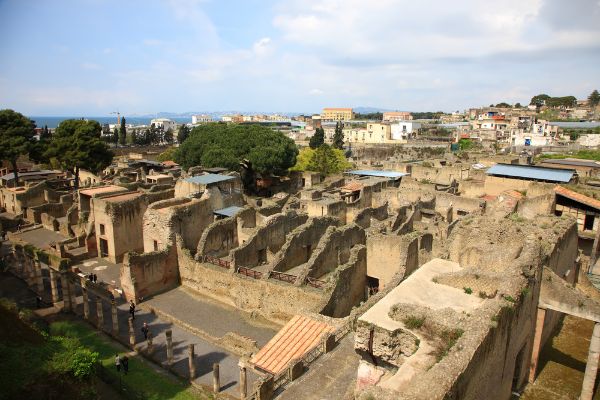
Herculaneum was a smaller coastal town: the walled area covered about 20 hectares and its population is estimated at roughly 4,000. Fast, extremely hot volcanic flows and later material buried it to a depth of about 20 metres, preserving carbonised wood, upper floors and domestic fittings rarely found elsewhere.
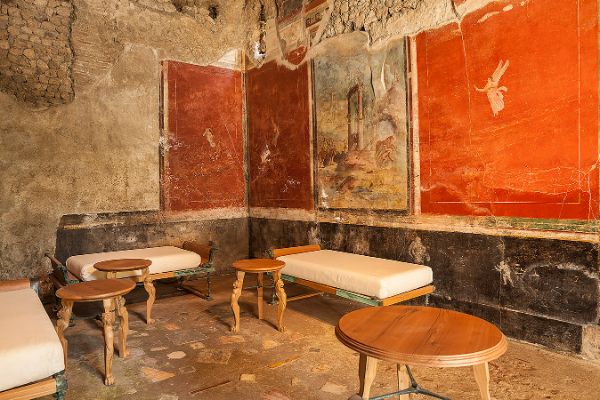
Why choose Pompeii
Pompeii allows you to move between forum, theatres, baths, shops, houses, gardens and city gates across a vast archaeological landscape. Its value lies in the relationships between these places. A map is essential, and a good guide can turn apparent ruins into a legible city.
The scale is also the difficulty. Distances are considerable, surfaces are uneven and shade is limited. Even a selective first visit normally requires several hours; trying to complete the site produces fatigue rather than understanding.


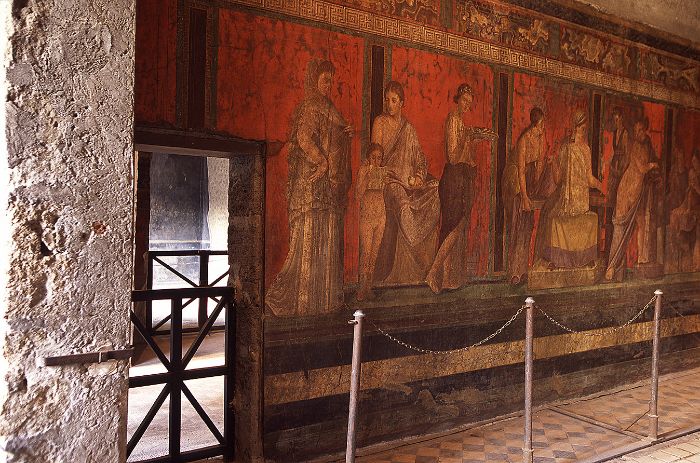
Why choose Herculaneum
Herculaneum is much smaller, but its preservation can be more immediate. Buildings retain upper levels, carbonised wood and architectural elements rarely encountered at Pompeii. Houses, shops and baths sit close together, allowing you to compare domestic spaces without covering the same distance.
The modern town rises directly around and above the excavation, making the depth of burial visible from the entrance. The compact site is easier to grasp in two or three hours, although steps, stone surfaces and exposure still require care.


Should you visit both?
Visiting both is valuable when Roman archaeology is a principal interest and your stay gives each site separate time. The contrast between Pompeii’s breadth and Herculaneum’s preservation becomes clearer when neither is rushed.
Combining both in one day is possible but demanding: it means extensive standing, two admissions, travel between sites and less attention at each. For most first visits, one site explored properly is a better use of the day.
Do not add Vesuvius automatically. The crater visit turns an already substantial archaeological day into a long, exposed itinerary. Our guide explains how to visit Mount Vesuvius independently and when to give it a separate half-day.
Time, heat and physical demands
Pompeii
Allow at least four hours for a selective route and longer for serious interest. Expect long distances, ancient paving, few shortcuts and limited shade.
Herculaneum
Two to three hours can provide a coherent visit. The site is compact but includes gradients, steps and uneven surfaces.
Summer
Begin early, carry water and protect against sun. The archaeological landscape can feel much hotter than the surrounding town.
Mobility
Neither site is completely step-free. Check Pompeii’s Pompeii for All route and Herculaneum’s official accessibility guidance before travelling.
Easy to reach from Naples or Sorrento
Both sites lie on the EAV Naples–Sorrento railway, usually described as the Circumvesuviana. You do not need a tour or a private transfer, although the ordinary trains can be busy and basic.
From Naples
Take a Sorrento-bound train from Napoli Porta Nolana or Napoli Piazza Garibaldi. Use Pompei Scavi–Villa dei Misteri for Pompeii, or Ercolano Scavi for Herculaneum.
From Sorrento
Take a Naples-bound train on the same line. Pompeii is the nearer stop; Herculaneum takes longer but remains direct, without a change.
Pompeii’s station is close to the Porta Marina entrance. From Ercolano Scavi, walk downhill along Via IV Novembre to Herculaneum; remember that the return to the station is uphill. Check the current EAV timetable shortly before travelling, as services and engineering work can change.
If you are staying in Positano, Praiano or Amalfi, allow for the journey to the railway or arrange a transfer: there is no direct train from these coastal towns. On a multi-centre holiday that includes Naples or Sorrento, it often makes sense to visit the archaeological sites during that part of your stay. Our guide to choosing between Sorrento and the Amalfi Coast explains the differences between these bases.
Tickets, official maps and planning
Pompeii uses named tickets and a daily limit of 20,000 admissions, with seasonal entry quotas. Carry the identification used for the booking and buy through the official Pompeii ticket page or its authorised seller. The €25 Pompeii+ ticket adds the suburban villas; most first-time visitors concentrating on the ancient city will not need it.
For Herculaneum, check the official ticket and opening information. If you are comparing a separate admission with a regional pass, use our Campania Artecard guide. An Artecard does not replace any mandatory reservation or site procedure.
Guide or no guide? Pompeii benefits greatly from a knowledgeable guide because of its scale. Herculaneum is easier to understand independently with the official map, although specialist interpretation still adds value.
Make the archaeological day part of Naples
Pompeii and Herculaneum are major reasons to spend longer in the Bay of Naples, but they should not reduce the city to a transport base. Return to the main Naples travel guide to balance one archaeological day with the historic centre, neighbourhoods and waterfront.





 Facebook
 WhatsApp channel
Leave a Reply