


The Bernina railway
Bernina Express: the route, the experience & the red train
Cross the Alps into Italy, understand the two train options and know what to expect when choosing your seats.
In this article
Choose your routeThe journey, stage by stageExpress or regional red train?Seats and direction of travelThe onboard experienceContinue your holiday in Italy
A scenic crossing, with two main starting points
The Bernina railway makes the journey into Italy part of the holiday. High mountain lakes, glacier views and tight curves above the valley give way to the gentler landscape around Tirano. Allow time to enjoy that change, with a Swiss overnight before the crossing and a stay beside Lake Como afterwards.
First choose where to start. Chur–Tirano combines the Albula and Bernina lines, including the Landwasser Viaduct. St Moritz–Tirano covers the shorter Bernina section, with the high pass, Alp Grüm and Brusio. Both can be travelled in either direction.
The usual through service from Chur runs via Pontresina; do not assume it calls at St Moritz. Check the actual departure and stops before choosing your Swiss hotel. The Albula and Bernina railway landscapes together hold UNESCO World Heritage status.
From viaducts and high lakes to Tirano
Chur to the Engadin: the Albula approach
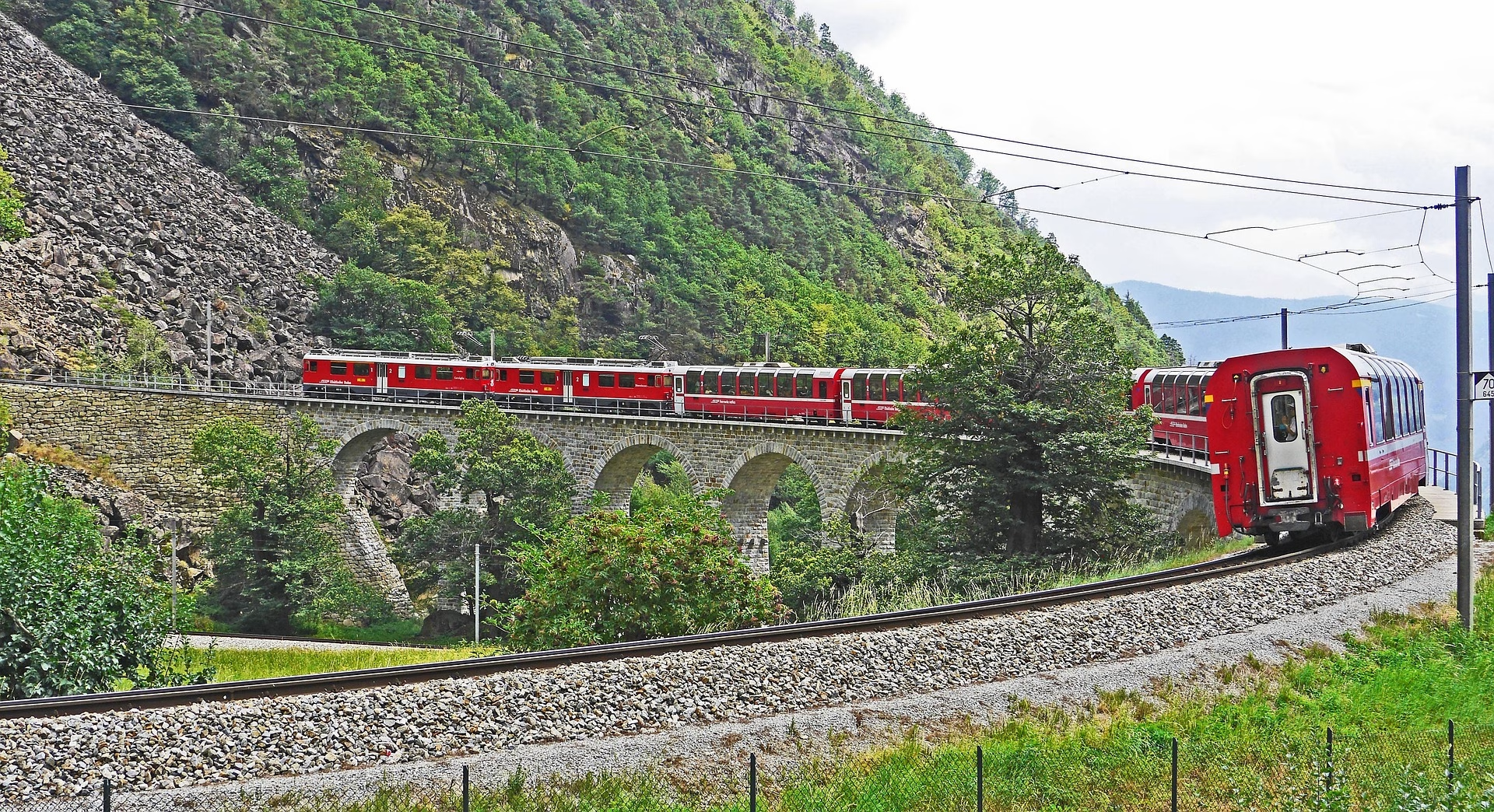
On the normal route south from Chur, the first part of the journey is about wooded valleys and railway engineering. Near Filisur, the Landwasser Viaduct curves into a tunnel in the rock face. Beyond Bergün, loops and tunnels gain height towards Preda and the Albula Tunnel, before the train reaches the Engadin.
This is the extra chapter you gain by starting in Chur. The Landwasser Viaduct is not on the St Moritz–Tirano route. If seeing it is a priority, check for diversions as well as checking your starting station.
Pontresina to Ospizio Bernina: above the trees
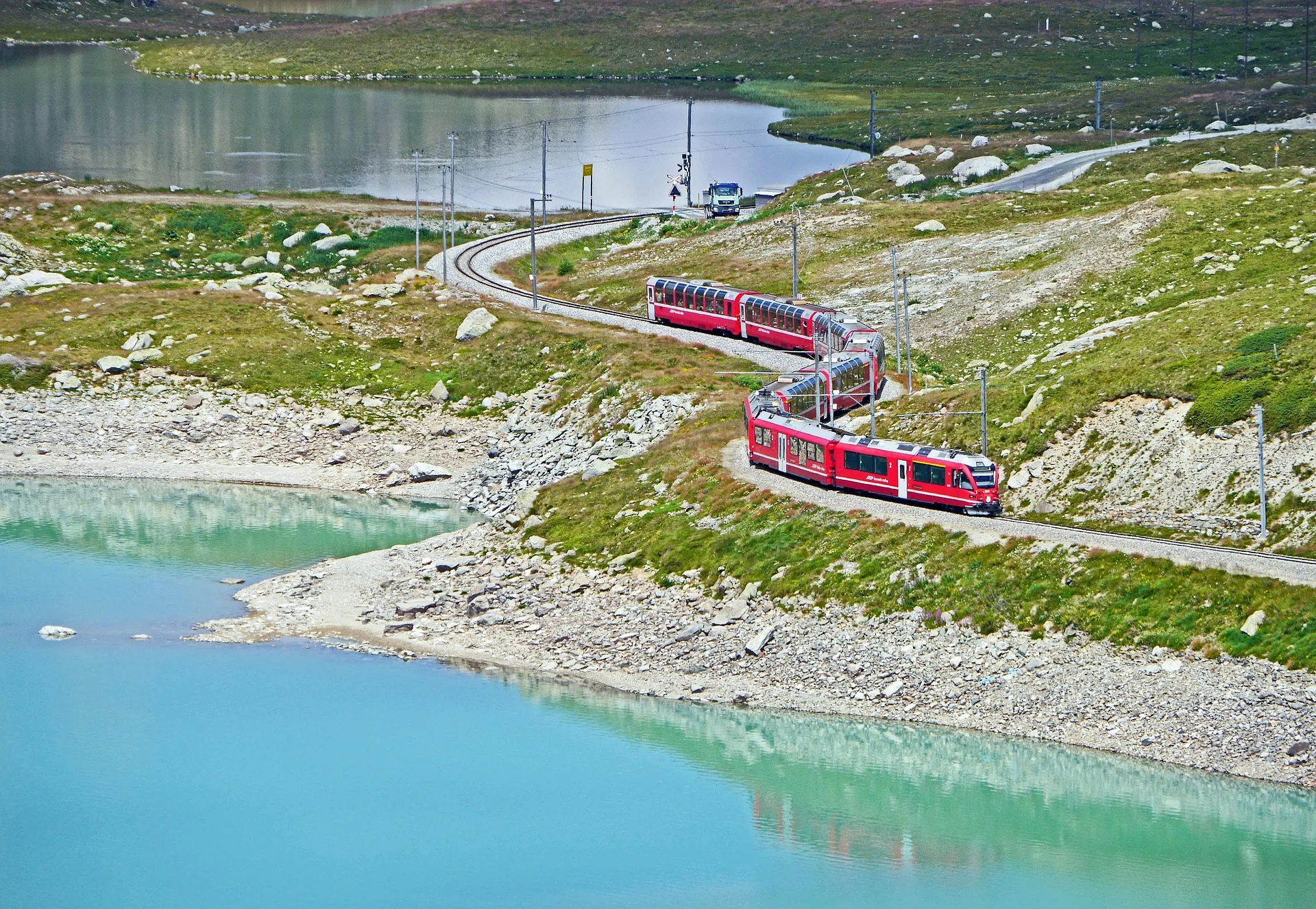
Beyond Pontresina, the Bernina section climbs towards the mountain landscape around Morteratsch. Trees become sparser and the view opens towards the Bernina massif. Near the summit, the railway runs beside Lago Bianco, reaching its highest point at Ospizio Bernina, 2,253 metres above sea level.
Here the attraction is the openness of the landscape: water, rock and mountain slopes close to the track. Snow cover and visibility vary with the season and weather; a summer photograph and a winter journey can look very different.
Alp Grüm to Poschiavo: the changing view
At Alp Grüm, look towards the Palü Glacier and down into Val Poschiavo. The descent brings repeated changes of perspective as the railway curves down the mountainside, returning to woodland and then the valley floor. Poschiavo makes a possible longer stop if you choose regional trains and plan the onward connections.
Lake Poschiavo, Brusio and Tirano
The line follows Lake Poschiavo before continuing to Brusio, where the circular viaduct allows the railway to lose height in a full loop. It is a very different sight from Landwasser: an open spiral close to the valley floor. The final stretch crosses into Italy and reaches Tirano, where the Swiss railway journey ends.
The crossing is enjoyable for this sequence as much as for any one landmark. Try to leave some time simply to watch it unfold, rather than treating each bend as a photograph to collect.
Open the route map
Bernina Express or the “red train”?
“Red train” is a nickname, not a precise booking category. Both services wear the railway’s red colours. Offers described as the Trenino Rosso or “Bernina Red Train” commonly refer to regional services; the name alone does not promise a seat in a Bernina Express panoramic carriage.
The Bernina Express is the named panoramic service. Regional trains are the regular services using the same railway. The choice changes how you travel, rather than giving one train access to a different mountain landscape.
| What changes? | Bernina Express | Regional red train |
|---|---|---|
| Carriages | Panoramic coaches with large windows curving towards the roof. | Regular RhB coaches with conventional windows. |
| Scenery | The Bernina line and its landmarks. | The same scenery when travelling the same section. |
| Booking | Valid ticket or applicable pass, plus a compulsory paid seat reservation. | Valid ticket or applicable pass; optional reservations on eligible St Moritz–Tirano services. |
| Onboard extras | Wi-Fi, digital route information and an at-seat snack and drinks service. | No equivalent Bernina Express catering or InfoT(r)ainment service. |
| Stops and flexibility | A reserved journey on a particular departure. | More departures and greater scope for planned stops, subject to ticket validity and connections. |
Choose the Bernina Express when you want to settle into a reserved panoramic seat and enjoy the crossing as one continuous journey. Choose regional trains when a longer break at a station matters more, allowing enough time for each onward service.
Regional reservations are optional, but RhB recommends them on the busy Bernina section. Availability is limited; travelling without one does not guarantee a seat. A reservation for a panoramic departure cannot simply be carried over to a later train after a stop.
When comparing an excursion or ticket offer, look for the exact train, carriage type, class and reservation included. A photograph of a red train is not enough to establish what has been booked.
Can you book a forward-facing seat?
You cannot know the carriage’s direction of travel when booking seats on the Bernina Express. RhB explains that coaches can be attached in either orientation. A seat number or booking diagram therefore cannot guarantee a forward-facing seat, or a particular side of the train for your journey.
The route direction—Chur to Tirano, for example—is known. It is the orientation of the carriage, and consequently your seat, that cannot be confirmed in advance. This applies even when you select a specific seat.
For two or more passengers, the railway suggests reserving seats opposite one another. That gives your party seats facing both ways, subject to availability; it does not turn an individual seat into a guaranteed forward-facing booking.
Views change from side to side as the track bends through the landscape. We would prioritise travelling together, a suitable class and a good connection over a promise of the “best side”. If facing backwards is a concern, tell us before booking so we can discuss the available seating arrangement.
What the journey feels like
The panoramic windows are particularly useful when the view rises above eye level: you can look up towards the mountains while remaining seated. First class gives you more space and fewer seats; second class shares the same route and panoramic-window experience. The reason to upgrade is personal comfort, rather than different scenery.
Expect a scenic railway journey with time to look around, rather than a high-speed transfer. Curves, station calls and the changing terrain set the pace. The panoramic glass can reflect the interior when taking photographs, so keep your camera close to the window and avoid using flash.
RhB describes the regional coaches as having windows that can be opened, which can appeal to photographers. Carriage equipment can vary, so do not make a particular opening window a condition of the trip. The panoramic coaches have fixed glazing.
There is a snack and drinks service on the Bernina Express, rather than a full restaurant-car meal. Plan lunch around the journey and keep water, a light layer and essentials close to hand. Luggage space is limited: manageable bags make the station changes easier.
Choose a departure that keeps the scenic stretch in daylight, especially during the shorter days. Allow room in the itinerary for weather and operational changes. If you need boarding assistance or a wheelchair space, arrange this in advance with the railway.
For a moving preview, watch the Bernina railway video previously featured in this guide.
From Tirano to Lake Como and beyond
At Tirano, change to the Italian railway for the route through Valtellina towards Varenna-Esino and Milan. Varenna is a useful arrival point for a Lake Como stay; plan the final transfer to your particular hotel, especially if it involves a ferry.
Our suggestion is to give the crossing its own day. Stay in Chur or the Engadin beforehand, then continue to the lake with a comfortable connection margin. That leaves space for lunch or a delay without turning the most scenic part of the holiday into a race.
A stay at Romantik Hotel Muottas Muragl is one option for time in the mountains. Its access arrangements need to fit your arrival and train departure. For a longer Swiss rail itinerary, the Glacier Express can be another stage, with enough nights between substantial travel days.
Check the timetable and route before booking, particularly if seeing the Landwasser Viaduct is a priority.
Useful railway information: See RhB’s Bernina Express timetable and service information, train comparison, regional reservations and seat-booking FAQs. Route highlights are also described by Switzerland Tourism; check onward connections with Trenord.
A railway crossing that fits your holiday
Tell us your dates, preferred pace and whether you would like panoramic seats or time for stops. We can arrange the rail journey, hotels and onward travel as part of your holiday in Northern Italy.



 Facebook
 WhatsApp channel
[…] Express, we recommend stopping for a couple of nights at the Romantick Muottas before boarding the Bernina Express to Tirano, in […]