


Make an evening at the Arena part of your Italy holiday
The 2027 opera season, seats that suit you and two distinctive places to stay—planned as a Verona city break or part of a longer journey.
In this article
An evening that gives Verona its own rhythm
Dinner in the historic centre, the walk into Piazza Bra and a full opera performed in a Roman amphitheatre: the Arena gives a Verona holiday a clear occasion to build around.
You can come for one carefully chosen performance, stay longer to hear two different operas, or make Verona the cultural opening to a holiday on Lake Garda or in the Dolomites. ExpertoItaly brings the performance, seats, accommodation and travel arrangements together.
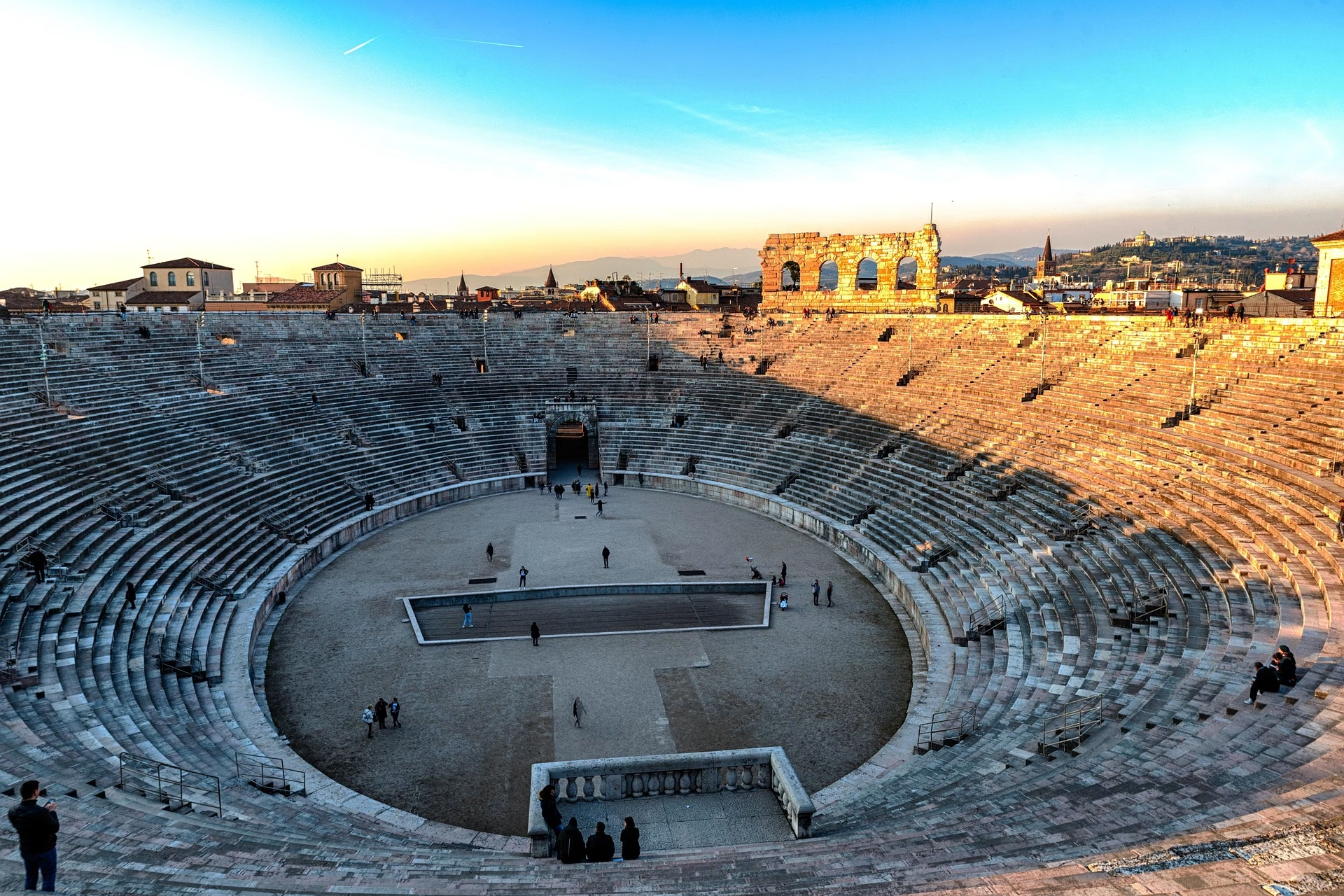
The Arena was built in the first century AD for public spectacles. Its modern operatic identity began on 10 August 1913, when the tenor Giovanni Zenatello and impresario Ottone Rovato staged Aida to mark the centenary of Verdi’s birth. The scale of the amphitheatre became part of the performance: large choruses, substantial sets and an audience rising around the stage.
That history helps explain why Aida still occupies such a prominent place. This is a fully staged opera festival, with orchestra, soloists and chorus, held outdoors in the centre of a working city. You do not need to be a regular operagoer to enjoy it; choosing the story, production and seat that suit you makes a difference.

What makes the 2027 season distinctive?
The programme places Verdi at its centre, with four operas presented in five productions: two very different Aidas, La Traviata, Nabucco and Bizet’s Carmen. The major addition is the return of full-length ballet after 34 years, with a new Romeo and Juliet set to Prokofiev’s music—a particularly fitting choice for Verona.
Aida: choose between two visions
Verdi’s story follows an Ethiopian princess enslaved in Egypt, caught between her love for the Egyptian commander Radamès and loyalty to her own people. The public spectacle surrounds a private tragedy of love, duty and political power.
The 1913 production, reconstructed by Gianfranco de Bosio, looks back to the festival’s beginnings through traditional Egyptian imagery and monumental scenery. It is the natural choice if you want to understand the Arena’s operatic heritage. Stefano Poda’s production, created for the centenary festival in 2023, uses light, reflective surfaces and contemporary visual design. The music and story are the same; the theatrical experience is markedly different.
La Traviata: intimacy behind the spectacle
Violetta, a Parisian courtesan, falls in love with Alfredo but faces social prejudice, family pressure and illness. Verdi’s 1853 opera puts a woman excluded by respectable society at its emotional centre. Paul Curran’s production places the story in early twentieth-century Paris, with a Moulin Rouge collaboration shaping the party scenes. Choose it for the human drama and the contrast between public celebration and private sacrifice.
Carmen: familiar music, a serious drama
Bizet’s opera is set in and around Seville. Carmen’s determination to remain independent collides with Don José’s possessiveness, ending in violence. Franco Zeffirelli’s large-scale staging gives the streets and crowds considerable presence. The Habanera and Toreador Song make it musically approachable for a first opera, while the story carries weight beyond those familiar melodies.
Nabucco: the power of the chorus
Verdi’s early success takes its story from the Babylonian conquest of Jerusalem, combining a ruler’s downfall, rival claims to power and the fate of a captive people. The chorus Va, pensiero gives their longing for home a collective voice. Stefano Poda’s production uses light and stylised imagery to give the ancient conflict a broader, contemporary resonance.
Ballet and special evenings
Alongside Romeo and Juliet, the season includes two Roberto Bolle & Friends ballet galas, Jonas Kaufmann in Opera, the immersive concerts Viva Vivaldi and Paganini Paradise, and Orff’s Carmina Burana. These are distinct concert or ballet experiences; choose a listed opera if you want a complete staged operatic story.
Explore the official festival programme. We can help you match the production to your interests and check the cast for your chosen date.
Arena di Verona 2027 performance calendar
Open each month for the scheduled performances and local start times. The festival is advertised from 11 June to 11 September; the current performance calendar begins with Aida on 12 June. The tariff page separately identifies an opening IX Sinfonia event on 11 June, whose detailed listing and start time should be confirmed before planning around it.
June 2027
| Date | Performance | Start |
|---|---|---|
| Aida — 1913 production | 21:30 | |
| Romeo and Juliet · ballet | 21:30 | |
| Aida — 1913 production | 21:15 | |
| Aida — 1913 production | 21:15 | |
| La Traviata | 21:15 | |
| Romeo and Juliet · ballet | 21:15 |
July 2027
| Date | Performance | Start |
|---|---|---|
| Carmen | 21:15 | |
| La Traviata | 21:15 | |
| Aida — 1913 production | 21:15 | |
| Roberto Bolle & Friends · ballet | 21:30 | |
| Carmen | 21:15 | |
| La Traviata | 21:15 | |
| Aida — 1913 production | 21:15 | |
| Romeo and Juliet · ballet | 21:15 | |
| La Traviata | 21:15 | |
| Carmen | 21:15 | |
| Aida — 1913 production | 21:15 | |
| Roberto Bolle & Friends · ballet | 21:30 | |
| La Traviata | 21:15 | |
| Aida — 1913 production | 21:15 | |
| Carmen | 21:15 | |
| Nabucco | 21:15 | |
| Carmen | 21:15 | |
| La Traviata | 21:15 |
August 2027
| Date | Performance | Start |
|---|---|---|
| Aida — 1913 production | 21:00 | |
| Nabucco | 21:00 | |
| Carmen | 21:00 | |
| Aida — 1913 production | 21:00 | |
| Jonas Kaufmann in Opera · gala | 20:15 | |
| Aida — Stefano Poda | 21:00 | |
| Carmen | 21:00 | |
| La Traviata | 21:00 | |
| Nabucco | 21:00 | |
| Carmen | 21:00 | |
| Romeo and Juliet · ballet | 21:00 | |
| Nabucco | 21:00 | |
| Aida — Stefano Poda | 21:00 | |
| Viva Vivaldi · immersive concert | 21:30 | |
| Paganini Paradise · immersive concert | 21:30 | |
| La Traviata | 21:00 | |
| Carmen | 21:00 | |
| Aida — Stefano Poda | 21:00 | |
| Carmina Burana · concert | 21:30 |
September 2027
| Date | Performance | Start |
|---|---|---|
| Aida — Stefano Poda | 21:00 | |
| Nabucco | 21:00 | |
| La Traviata | 21:00 | |
| Carmen | 21:00 | |
| Aida — Stefano Poda | 21:00 | |
| Nabucco | 21:00 | |
| Carmen | 21:00 | |
| La Traviata | 21:00 |
Programme and times checked on 10 October 2026 against the official Arena calendar; subject to change. The calendar above reflects Carmen on 27 August.
Hear more than one opera
The weekends of 2–4 July and 9–11 July each bring together Carmen, La Traviata and the historic Aida. Later in the season, 2–5 September offers Poda’s Aida, Nabucco, La Traviata and Carmen on successive evenings. Choose one or two, leaving time to enjoy Verona between performances.
Understanding the seating plan
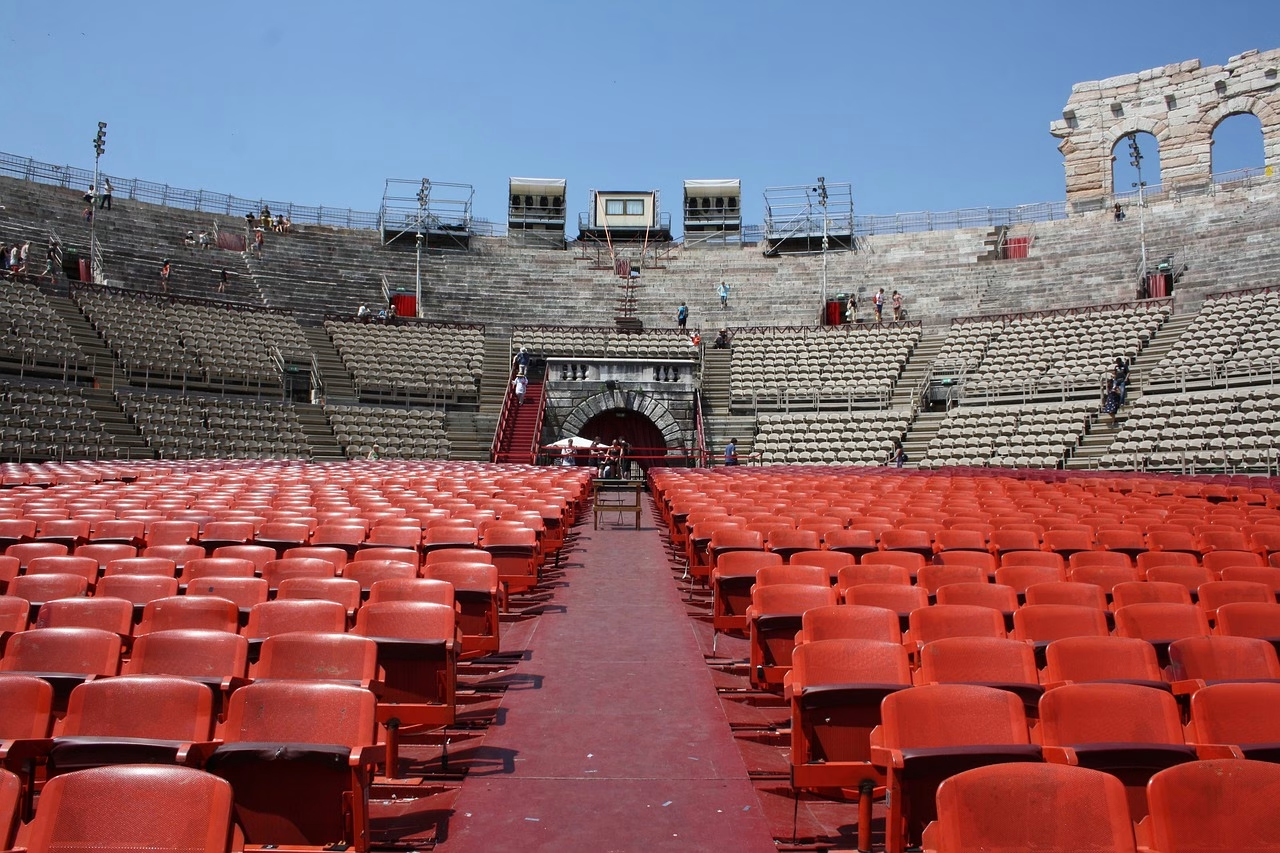
The Arena has a large floor seating area facing the stage and tiers curving around it. All categories in the published 2027 plan are numbered, including the stone steps. A numbered place does not necessarily mean a chair.
Open the official 2027 seating plan (PDF) · See the official sector diagrams
View the detailed official seating plan
The detailed plan is provided by Fondazione Arena di Verona. Open it to enlarge seat numbers, category colours and entrance gates.
Padded chairs: Poltronissima, Platea and Tribuna
These have upholstered seats and backrests. The Platinum categories occupy the front central floor area; Platinum Premium is the first row. Gold, Silver, Silver Easy, Poltronissima and Platea cover other floor positions, while Tribuna occupies designated areas on the tiers. The precise row and angle matter as well as the category.
For a holiday built around the opera, we would usually begin by comparing a good central padded seat with your budget. The most expensive front row gives proximity; a little more distance may make it easier to take in the full stage.
Verdi, Puccini and Rossini: chairs on the tiers
The first three numbered sectors have individual, unpadded seats with backrests. Their raised position offers a broader perspective on the staging, with the trade-off of steps and increasing distance or a more sideways angle, depending on the seat.
Fourth, fifth and sixth sectors: stone steps
These are numbered places on the amphitheatre’s stone terraces, without a chair or backrest. They offer a lower-cost way to experience the setting, but comfort matters during a long opera. A cushion is useful. For limited mobility or difficulty sitting for extended periods, tell us before we select a sector.
How much do Arena tickets cost?
The table shows standard adult face-value prices in euros, per person for one performance. These are ticket prices, separate from accommodation and your holiday arrangements. Any booking or service fees are identified when the tickets are quoted.
For eligible ordinary opera dates, early-booking prices apply to purchases made by 4 November 2026. The second column shows the published tariff from 5 November. Some premium categories do not change.
| Seat category | By 4 Nov | From 5 Nov |
|---|---|---|
| Poltronissima Platinum Premium | €345 | €345 |
| Poltronissima Platinum | €300 | €300 |
| Poltronissima Gold | €245 | €245 |
| Poltronissima Silver | €190 | €210 |
| Poltronissima Silver Easy | €173 | €190 |
| Poltronissima | €165 | €180 |
| Poltrona Platea | €135 | €150 |
| Poltrona Tribuna | €125 | €135 |
| 1st sector · Verdi | €120 | €130 |
| 2nd sector · Puccini | €95 | €105 |
| 3rd sector · Rossini | €70 | €80 |
| 4th sector · stone steps | €60 | €63 |
| 5th sector · stone steps | €43 | €45 |
| 6th sector · stone steps | €28 | €35 |
The early-booking column excludes first performances and the opening nights. Aida on 7 August and Nabucco on 15 August already use the higher ordinary-opera tariff. Prices checked on 10 October 2026.
Why the headline “from” price can be misleading
The advertised €23 starting price for opera is a concession rate. For an eligible ordinary opera date, the lowest standard adult price is currently €28 in the sixth sector, rising to €35 after the early-booking period. The distinction is important when comparing offers.
As a practical comparison, two standard adult tickets for an eligible ordinary opera currently cost €190 in Puccini, €270 in Platea or €380 in Silver, before any applicable fees.
Opening nights, first performances, ballet and gala prices
Opening tariff: 11 and 12 June. First-performance tariff: La Traviata 25 June, Carmen 2 July, Nabucco 29 July and Poda’s Aida 12 August. The Kaufmann gala on 8 August also uses this tariff. The final column applies to the other listed ballet and concert evenings.
| Seat category | Opening nights | First performances / Kaufmann | Other ballet / concerts |
|---|---|---|---|
| Poltronissima Platinum Premium | €420 | €345 | €305 |
| Poltronissima Platinum | €365 | €300 | €265 |
| Poltronissima Gold | €295 | €245 | €220 |
| Poltronissima Silver | €265 | €210 | €195 |
| Poltronissima Silver Easy | €265 | €210 | €175 |
| Poltronissima | €230 | €180 | €165 |
| Poltrona Platea | €200 | €150 | €140 |
| Poltrona Tribuna | €200 | €135 | €125 |
| 1st sector · Verdi | €155 | €130 | €115 |
| 2nd sector · Puccini | €125 | €105 | €95 |
| 3rd sector · Rossini | €100 | €80 | €70 |
| 4th sector · stone steps | €75 | €63 | €52 |
| 5th sector · stone steps | €55 | €45 | €35 |
| 6th sector · stone steps | €38 | €35 | €30 |
Concessions are available in selected categories for under-30s and over-65s. A limited under-30 Platea allocation is priced at €30, with date restrictions. We check eligibility and availability when preparing your proposal.
See the official 2027 prices and concessions. Seats remain subject to availability; an early enquiry gives us more choice of suitable seats and small hotels on the same dates.
Our suggested accommodation
The best base depends on how Verona fits into the rest of your holiday. For a central stay without a car, choose Butterfly. For a self-drive journey with a quieter hillside setting, consider Relais Fra’ Lorenzo.

Butterfly Boutique Rooms
A small, design-led address in central Verona, within walking distance of the Arena. It suits travellers who want to explore the city on foot, go out for dinner and return independently after the performance.
It also fits a rail holiday combining Verona with another Italian city.

Relais Fra’ Lorenzo
Gardens, a pool, on-site parking and views across Verona make this hillside property a good fit for a road trip through northern Italy. The setting gives you somewhere quieter to return to between city visits.
For the opera, we suggest arranging transport into the centre and back afterwards, leaving the car at the hotel. The uphill return is an important difference from a central stay.
Make the opera the focus—or part of a longer journey
A Verona city break
Build the stay around one or two performances and let the days reveal a different city: Roman streets, the Scaliger family’s medieval monuments, Castelvecchio, Palazzo Maffei and the gardens across the Adige. A private introductory walk can bring these periods together.
There is no need to leave immediately after the opera. A longer stay makes room for Valpolicella, Vicenza, Lake Garda or Borghetto sul Mincio and the Sigurtà gardens. Our Verona city guide explains why this compact city rewards time.
A car-free multi-centre holiday
Combine Verona with Venice, Padova or Milan, travelling between the cities by rail. Butterfly keeps your Verona days straightforward. We place the opera within the stay so that a late finish is followed by a relaxed morning rather than an early transfer.
A self-drive holiday through northern Italy
Verona pairs naturally with Lake Garda, the Dolomites or the Prosecco Hills. Relais Fra’ Lorenzo provides parking and a quieter base while you enjoy the city. For many 10–14-night holidays, Verona and one contrasting base give a comfortable balance of culture and landscape.

Browse our Verona holidays or use Padova and Verona and Verona, Merano and Lake Garda as starting points for a route tailored to you.
Plan for a full evening
Allow time for dinner and entry. The Arena asks spectators to arrive at least an hour before the performance; gates open two hours before the start. Many evenings begin at 21:00 or 21:15, with exceptions shown in the calendar.
Expect a late finish. The published durations are approximately 3 hours 40 minutes for the historic Aida and 3 hours 10 minutes for Poda’s version, including intervals. A central hotel or an arranged return makes a substantial difference.
Follow the story in English. The listed operas offer Italian and English surtitles. Reading a short synopsis beforehand helps you enjoy the music and staging without following every line.
Dress for the occasion and the setting. Smart clothing suits the padded floor seats; the Arena does not permit men’s shorts, vests or flip-flops in the platea. Bring a light layer for later in the evening and a cushion if choosing stone steps.
Tell us about access requirements early. The ancient tiers involve steps. We check suitable seating and the Arena’s dedicated arrangements before booking. As an outdoor venue, weather can affect performances; we explain the applicable ticket conditions with your proposal.
Read the Arena’s practical visiting information and ticket and weather conditions.
Tell us which evening you have in mind
Send us your preferred opera, approximate travel dates and whether you would like a Verona city break or a longer journey. We will suggest seats, accommodation and a route that work together, with a tailored price and clear inclusions.
Our holidays are land-only. Flights are booked separately.



 Facebook
 WhatsApp channel