Turin is Italy’s first modern capital and one of its most coherent cities. Its centre was planned rather than accumulated, and it is best understood through structure, continuity, and use rather than isolated landmarks.


Its institutions were designed to function, not to impress, and many of its daily habits began as practical solutions that later became national standards.
The result is a city in which form, use, and continuity matter more than display.
Turin’s historic centre, largely shaped in the 18th and 19th centuries, is defined by long axial streets, uniform façades, formal squares, and an extensive system of porticoes — producing a level of architectural consistency rare among European capitals. The city does not call for attention; it becomes legible through it.

This travel guide explains how to read Turin district by district, for travellers who value understanding over spectacle.

How the city is organised
Turin unfolds as a sequence of districts, each shaped by a distinct phase of its history and still legible today.
The Quadrilatero Romano preserves the Roman grid of Augusta Taurinorum, with narrow streets, piazzas, and remains embedded in daily circulation.

Piazza Castello and the civic core show how Savoy power organised the city through palaces, churches, and state institutions.
Borgo Nuovo, extending towards the river, records the period in which modern Italy was debated and formalised.
Via Cernaia, Piazza Solferino, and Porta Susa reflect the transformation from military infrastructure to administrative and residential use.
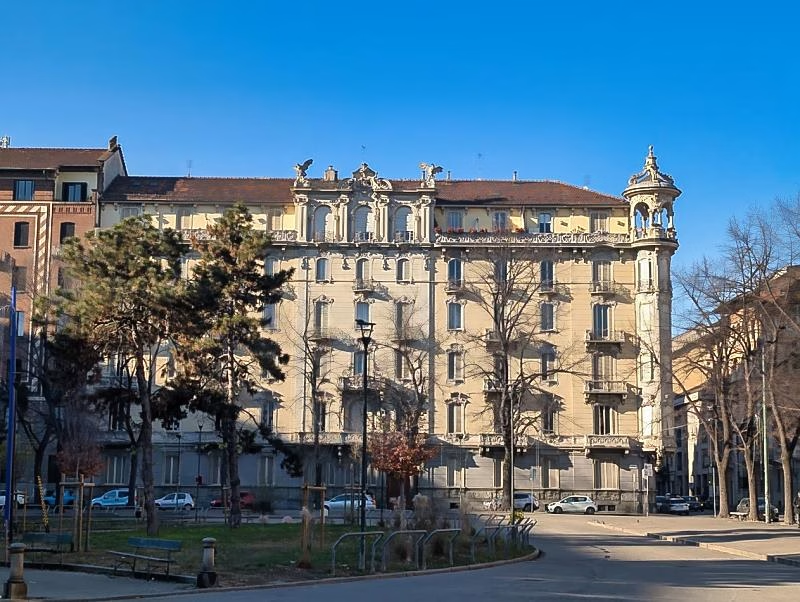
Cit Turin and San Donato express the Liberty season, when early-20th-century architecture reshaped former service areas into residential neighbourhoods.
La Crocetta continues this expansion, defined by broad avenues, Liberty villas, and long-established markets.
Murazzi del Po and Valentino Park mark the city’s relationship with the river, combining public space, infrastructure, and long linear walks.
San Salvario and Nizza–Millefonti trace Turin’s industrial and exhibition history, from factories to large-scale architectural reuse.
Borgo Vanchiglia reflects 19th-century expansion beyond the walls, closely tied to education and housing.
Aurora, to the north, represents Turin’s social and educational tradition, shaped by Don Bosco, the Salesians, and charitable reform.
Each district adds a layer to the city’s story. None replaces the previous one.
Everyday inventions that travelled far
Many elements of Italian daily life originated in Turin.
The Gianduiotto (1865) was the first individually wrapped chocolate.
The tramezzino was created in a café near Piazza Castello.
Grissini were developed for a Savoy duke’s diet.
Vermouth was perfected by Martini & Rossi — Torino still appears on every label.
Coffee culture evolved from historic cafés to global brands such as Lavazza and Caffè Vergnano.
The first chocolate-coated ice cream on a stick was patented here.
These were not conceived as symbols.
They became habits through use.


Industry at the heart of the city
Turin is Italy’s industrial capital by design.
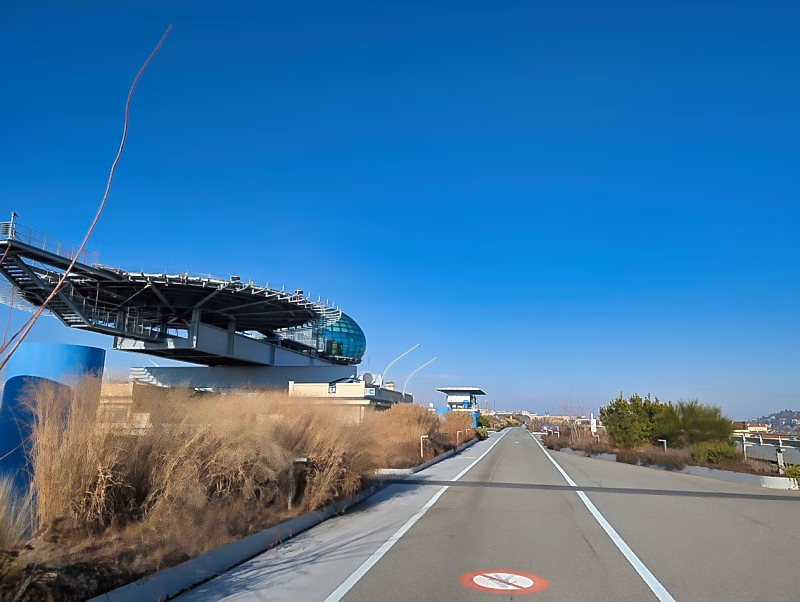
FIAT shaped housing, transport, and social structure from within the city itself. At the Lingotto factory, cars were assembled floor by floor and tested on the rooftop track, later reused rather than abandoned.
Factories were integrated into the urban fabric and subsequently adapted rather than removed. This continuity explains why industrial architecture in Turin remains embedded rather than residual.
Institutions that still function
Turin invested early in institutions — schools, universities, markets, museums, hospitals — and many remain active.
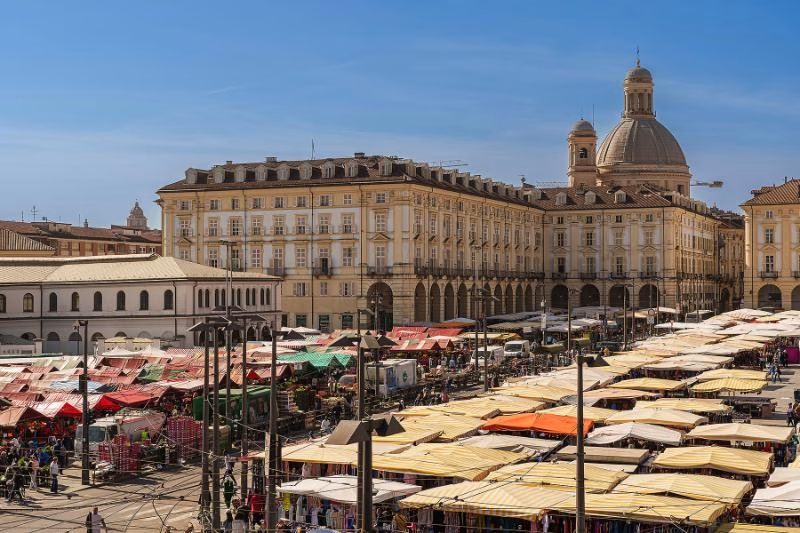
This is why Porta Palazzo, Europe’s largest open-air market, feels essential rather than staged. It is not an attraction added to the city; it is part of the city’s daily operation.
The same principle applies across Turin’s districts: interest lies less in constant activity than in continuity of use.
Visiting Turin

Turin is best explored by district, not by checklist.
Each area tells a specific story — political, social, industrial, residential — and the city makes sense when these are read together. You do not need to see everything. You need to understand where you are.
The guides that follow are designed to provide orientation and context, allowing you to choose pace, depth, and focus — whether you stay two nights or return repeatedly.
Turin reveals itself through attention rather than display.


Turin Grand Guide
Start with the foundations |
Read the modern city |
Follow the river and industry |
Social Turin |
You are in good hands




Tailor-made Italy holidays, designed personally by Antonio Cresce.
Characterful places to stay, thoughtful routes and well-planned travel between them — across one region or several.
We arrange your accommodation, transport and experiences in Italy. Flights are booked separately.
Meet Antonio & discover ExpertoItalyPlan with ExpertoItaly
Tell me where you would like to go, when you can travel and what matters to you.
Start planning your Italy holidayMonday–Thursday: 9am–6pm
Friday: 9am–5.30pm · UK time
At weekends, please send an enquiry.
Your holiday protection

Travel Trust Association
Member Q8055
Read how your holiday payments are protected through our TTA membership.
How your holiday is protectedItaly ideas and travel advice by email
Subscribe for destination ideas, places to stay and practical advice from ExpertoItaly.
We will never sell your details. Read our privacy policy.
Follow ExpertoItaly
 Facebook
 WhatsApp channel
Follow our travel updates. For help planning your own holiday, contact Antonio directly.
ExpertoItaly Ltd · Company registration no. 12035194 · TTA membership Q8055
Package holidays are sold by ExpertoItaly Ltd. Registered office: 33 Miles Close, London, SE28 0NJ.