Reading Turin’s civic city, one street at a time


Planned rather than improvised, residential rather than theatrical, this district reveals itself through proportion, alignment, and small factual details rather than grand gestures.
It is an area best explored slowly. The interest lies not in landmarks alone, but in how streets connect, how façades repeat, and how history is embedded in everyday buildings still in use.

Church of San Filippo Neri
One of Turin’s largest churches by internal volume, San Filippo Neri is deliberately restrained on the outside, blending into the street rather than dominating it.
Its vast interior reveals itself only once inside — a recurring trait of Borgo Nuovo, where scale and ambition are often concealed behind measured façades.
Built in the 17th century and expanded over time, the church reflects a civic Baroque rooted in function and continuity rather than theatrical display.
This is the kind of city Turin is — and why it rewards the kind of traveller we design for
Borgo Nuovo stretches between Via Roma, Corso Vittorio Emanuele II and the Po. It was conceived in the early 17th century as Città Nuova, a forward-looking expansion that replaced defensive logic with order, light, and legibility.
This was not courtly Turin, but the city of administrators, professionals, and institutions.
The dismantling of the city walls during the Napoleonic period reinforced this character. Bastions disappeared, green spaces replaced fortifications, and Borgo Nuovo settled into the calm, measured urban fabric that still defines it.
What to look out for while walking
Taken together, these places explain why Turin feels different from Italy’s better-known cities — quieter, more civic, and shaped by ideas as much as by power.
- Piazza Carlo Emanuele II (Piazza Carlina) — a domestic, lived-in square whose scale and daily rhythms contrast with Turin’s grand ceremonial spaces. Behind it lay the historic Jewish quarter, formally established in 1679.
- Via Lagrange — today a commercial artery, originally a residential civic axis. Look up to read the 18th- and 19th-century proportions above shop level.
- The “Casa senza finestre” — an apparently blank façade along Via Lagrange, explained not by symbolism but by historic interior layouts and property boundaries.
- Chiesa di San Filippo Neri — one of Turin’s largest churches by volume, unusually austere on the outside and revealing its scale only once inside.
- Palazzo Priotti — a late-19th-century palazzo that reflects the sober confidence of professional Turin rather than aristocratic display.
- Pepino — founded in 1884, this historic café is credited with inventing the chocolate-coated ice cream on a stick, a small but telling example of Turin’s applied ingenuity.
- Caffè Fiorio — founded in 1780 along Via Po, it became a regular meeting place for students, academics, and political figures linked to the nearby university, reflecting the street’s long-standing role in Turin’s intellectual and civic life.
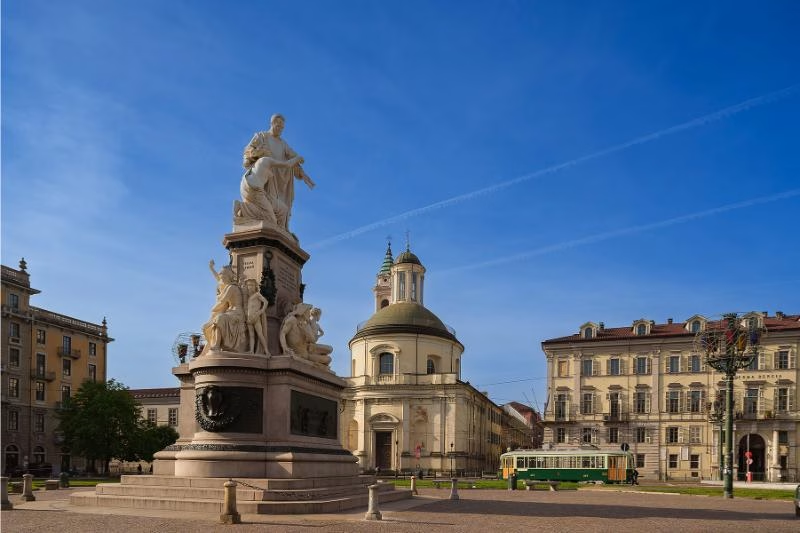
Piazza Carlo Emanuele II, known as Piazza Carlina, marks a quieter register of Borgo Nuovo. Smaller and more domestic than Turin’s ceremonial squares, it has long been shaped by residential life, cafés, and daily crossings rather than monuments. Behind the square lay the historic Jewish quarter, while today its calm proportions and lived-in atmosphere capture the district’s transition from Baroque planning to everyday conviviality.

Casa senza finestre
Located at the corner of Via Lagrange and Via Andrea Doria, the so-called “House Without Windows” was designed in 1848 by Alessandro Antonelli. Despite appearances, the building is not windowless: its living spaces face an internal courtyard, while the street façade was conceived as a continuous architectural screen. Balconies and railings replace visible openings, preserving symmetry and reducing noise from the street. In some sections, painted elements were used to maintain visual balance, making the building a discreet example of Turin’s 19th-century experimentation with form, function, and illusion.

Palazzo Priotti (Casa Priotti)
Standing on Corso Vittorio Emanuele II, Palazzo Priotti is one of the buildings that signals Turin’s shift from Baroque order to early modern ambition. Completed around 1901 by Carlo Ceppi, it blends late Neo-Baroque exuberance with emerging Liberty details. Look up to notice the sculpted decoration, bow windows, and wrought-iron balconies. Beneath the ornament, the building was structurally advanced for its time, using reinforced concrete — a reminder that Turin’s elegance was often matched by technical innovation.

Accademia delle Scienze di Torino
The building now housing the Museo Egizio was originally the Collegio dei Nobili, reassigned in the late 18th century to the Accademia delle Scienze di Torino. Founded privately in 1757 and officially recognised in 1783, the Accademia functioned as a scientific council advising the Savoy state on education, research, and modernisation. After the suppression of the Jesuits, the palace was renovated to accommodate this role, including the conversion of the former theatre into the Sala dei Mappamondi, decorated with symbols of the emerging modern sciences.

Via dei Mille
A late-19th-century residential street that captures Borgo Nuovo at its most composed.
The palazzi here were built for Turin’s professional classes rather than the court: regular façades, restrained decoration, and an emphasis on proportion and livability. It is a good example of how the district evolved from Baroque planning into a quieter, ordered urban fabric before the arrival of Liberty architecture elsewhere in the city.
Institutions you encounter along the walk
- Accademia delle Scienze (Museo Egizio building) — before housing the Egyptian Museum, this was the seat of the Accademia delle Scienze di Torino, founded privately in 1757 as a council of young scholars advising the Savoy state on scientific research, education, and modernisation. Recognised officially in 1783, it brought together Piedmontese and international Enlightenment figures and was housed in the former Collegio dei Nobili, renovated after the suppression of the Jesuits.
- Museo del Risorgimento (Palazzo Carignano) — housed in one of the most distinctive Baroque palaces in Turin, designed in the late 17th century with a curved brick façade and complex interior plan. The building later became the seat of Italy’s first Parliament, where the Statuto Albertino was issued, before being converted into a museum.
- Museo Egizio — founded in 1824, it holds over 40,000 artefacts, with more than 10,000 on display, making it the most extensive Egyptian collection outside Egypt and second only to Cairo.

Palazzo Carignano – Piazza Carignano façade
The original Baroque façade of Palazzo Carignano, designed in the late 17th century by Guarino Guarini. Built in exposed brick with a concave–convex rhythm, it breaks with classical symmetry and marks one of the most experimental moments of Baroque architecture in Turin. This side reflects the palace’s original role as a dynastic residence within Borgo Nuovo.

Palazzo Carignano – Piazza Carlo Alberto façade
The later 19th-century façade overlooking Piazza Carlo Alberto, added when the building became the seat of Italy’s first Parliament. More regular and monumental in character, it reflects the shift from private residence to civic institution, aligning the palace with the political life of Turin during the years leading to Italian unification.

Italy before unification (context)
Until the mid-19th century, Italy was not a single country but a collection of independent states. Political unification began in the 1860s under the House of Savoy, making Italy one of the youngest nation-states in Europe.

Caffè Fiorio
Founded in 1780, Caffè Fiorio was more than a café. As recorded on the historical plaque displayed here, it hosted student movements in 1821 and later became a regular meeting place for political figures during the Risorgimento. Renovated in the mid-19th century, it attracted members of the aristocracy as well as writers and travellers, including Herman Melville and Mark Twain, drawn to the intellectual life that unfolded beneath Turin’s porticoes.

Monumento a Giuseppe Mazzini
This seated bronze monument, completed in 1917, honours Giuseppe Mazzini, one of the intellectual architects of Italian unification. Unlike the Savoy-led monarchy that made Turin the first capital of Italy, Mazzini believed in a republican nation shaped by civic responsibility and popular participation. The reliefs around the base depict ordinary men and women — workers, artisans, citizens — reflecting his vision of a nation built from the ground up. Its calm, reflective pose contrasts with the political tensions it represents, making it a quietly revealing stop while walking through this part of the city.
Where the walk opens out
- Via Po — opened in the late 17th century as a direct connection between Piazza Castello and the river, defined by continuous porticoes
designed to support movement, commerce, and university life in all seasons. - Murazzi del Po — built as river infrastructure along the Po, these arcaded embankments once supported trade and transport and now frame
pedestrian movement along the water. - Piazza Vittorio Veneto — one of Europe’s largest arcaded squares, conceived as the urban threshold between the city and the river, where
Borgo Nuovo opens onto landscape.

Via Po
Opened in the late 17th century as part of the Città Nuova expansion, Via Po forms a direct axial link between Piazza Castello and the river. Its continuous porticoes were conceived as urban infrastructure, allowing movement, trade, and university life to continue in all seasons. The street marks the transition from the royal core of Turin to the civic and institutional fabric of Borgo Nuovo.

Via Po porticoes
Look closely as you walk along Via Po and you’ll notice a subtle difference between the two sides of the street. On the left, heading from Piazza Castello toward the river, the porticoes run without interruption: even at crossroads, covered arches allow you to pass without stepping into the open. On the opposite side, the arcades break at each intersection. This asymmetry was intentional. In the 19th century, the continuous side was commissioned to allow covered passage between the Royal Palace and the church of the Gran Madre di Dio, turning a practical concern — staying dry — into a permanent feature of Turin’s urban design.


Murazzi del Po — the arcaded riverfront running below Borgo Nuovo. Built in the 19th century as working river infrastructure, the Murazzi now form one of Turin’s most lived-in promenades, where cobbled paths, bridges, cafés, and long views along the Po bring the city gently to the water.


Piazza Vittorio Veneto
Conceived in the early 19th century, Piazza Vittorio Veneto is one of Europe’s largest arcaded squares and marks the point where Borgo Nuovo opens toward the river. Its uniform façades and continuous porticoes extend the civic order of the city to the edge of the Po, transforming a natural boundary into a structured urban threshold.
Borgo Nuovo no longer represents civic power in a formal sense, yet it remains one of the clearest expressions of how Turin was shaped. Planned in the Baroque period and later absorbed into the rhythms of modern life, it is today a district of shopping streets, residential palazzi, cafés, and institutions woven into everyday use. Its value lies not in monumentality, but in continuity: a part of the city where historical ambition has settled into proportion, conviviality, and habit. Turin reveals itself most clearly to travellers who appreciate this balance — elegant without excess, social without spectacle, and deeply shaped by how people have lived rather than how power has been displayed.
You’re in good hands
Clients often mention what matters most — care, precision, and the sense of travelling with someone who knows the way.
STAY CONNECTED WITH US (it’s free!)
Unlock insider tips on Italy’s hidden gems, free every month!
👍 Follow us on Facebook – Stay inspired with daily updates, travel ideas, and a community of fellow Italy lovers.

📲 Join our WhatsApp channel 🟢 – Get instant updates, behind-the-scenes insights, and connect directly with our team.

We’ll always treat your details with the utmost care and will never sell them to other companies. See our privacy policy
Package holidays are sold by ExpertoItaly Ltd (Reg. 12035194)
Call us on +44 (0) 77 3838 5790
Registered office: 33 Miles Close, London, SE28 0NJ

Business Hours
Monday – Thursday 9am to 6pm
Friday 9am to 5:30pm
Saturday – please send us an enquiry form
Sunday – please send us an enquiry form