Palermo is a capital city with a beach chapter, not a resort with monuments attached. Its Phoenician harbour, Islamic urban legacy, Norman court, Spanish avenues, Liberty villas, working markets and civic response to Mafia violence can all be read within one stay—provided the city and Mondello are given enough time to connect.
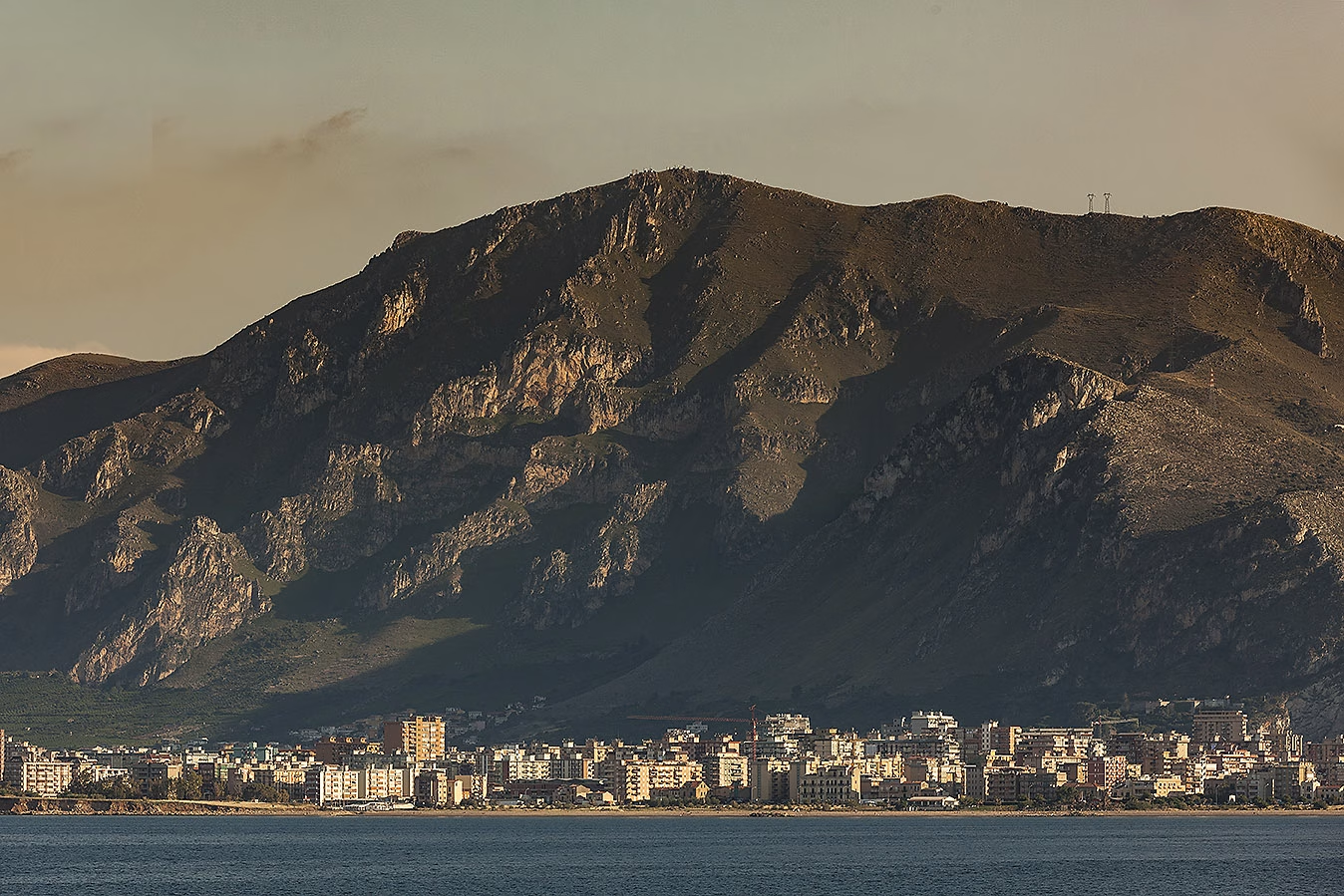
Palermo developed beside a protected harbour, with Monte Pellegrino and the mountains enclosing the fertile plain behind the city.
Palermo is not a city that yields everything at first glance. Grand churches stand beside damaged palaces; market streets run through districts whose names preserve Arabic origins; theatrical Baroque interiors sit inside restrained oratories; and nineteenth-century boulevards lead towards a coastline reshaped by modern expansion. Its beauty is real, but so are the breaks in its history.
That complexity is the reason to stay rather than pass through. A well-paced
visit moves from the old harbour and royal city to the markets, La Kalsa and
the Liberty expansion, then out towards Monte Pellegrino and Mondello.
Palermo can consequently work as one of
Sicily’s most rewarding cultural sea breaks
,
as well as the opening chapter of a longer Sicilian journey.
THE CITY BEFORE THE MONUMENTS
How geography made Palermo
Palermo occupies the north-western coast of Sicily, facing the Tyrrhenian Sea and backed by a semicircle of limestone mountains. For centuries the city looked across the Conca d’Oro, the fertile plain once filled with citrus groves, gardens and water channels. Much of that landscape has been absorbed by twentieth-century development, but the mountains still make Palermo’s setting immediately legible.
The first settlement stood on a slightly raised coastal platform between two watercourses, the Papireto to the north and the Kemonia to the south. Both now run underground, but they once defined a narrow peninsula reaching towards a sheltered inlet. The ancient east–west route along that ridge survives in the Cassaro, now Via Vittorio Emanuele, linking the royal palace at the upper end of the city with the sea at Porta Felice.
This was an unusually strong position: a defensible harbour close to North Africa, Sardinia and the western Mediterranean, with fresh water and productive land immediately behind it. Palermo’s successive rulers did not choose the city by accident. Phoenician merchants, Carthaginian administrators, Roman officials, Muslim governors, Norman kings and Spanish viceroys all used the same relationship between harbour, plain and mountain.
Monte Pellegrino marks Palermo’s northern edge and separates the urban coastline from the bay of Mondello.
Palermo in nine turning points
Seventh century BCA stable Phoenician settlement develops beside the harbour; Palermo remains within the Punic sphere until the Roman conquest.
254 BCRome captures Panormus during the First Punic War.
831Muslim forces take the city. Balarm becomes the political and commercial centre of Islamic Sicily.
1072–1130The Normans take Palermo; Roger II later makes it the capital of the Kingdom of Sicily.
1282The Sicilian Vespers ends Angevin control of the island and opens the Aragonese phase.
1492The Spanish monarchy orders the expulsion of Sicily’s Jewish communities.
1860–61Garibaldi’s campaign brings Palermo into the political process that creates unified Italy.
1943Heavy Allied bombing causes lasting damage to the historic centre before Allied forces enter the city.
1992The murders of Giovanni Falcone and Paolo Borsellino provoke mass public anger and become a defining point in Palermo’s anti-Mafia history.
Monte Pellegrino and Santa Rosalia
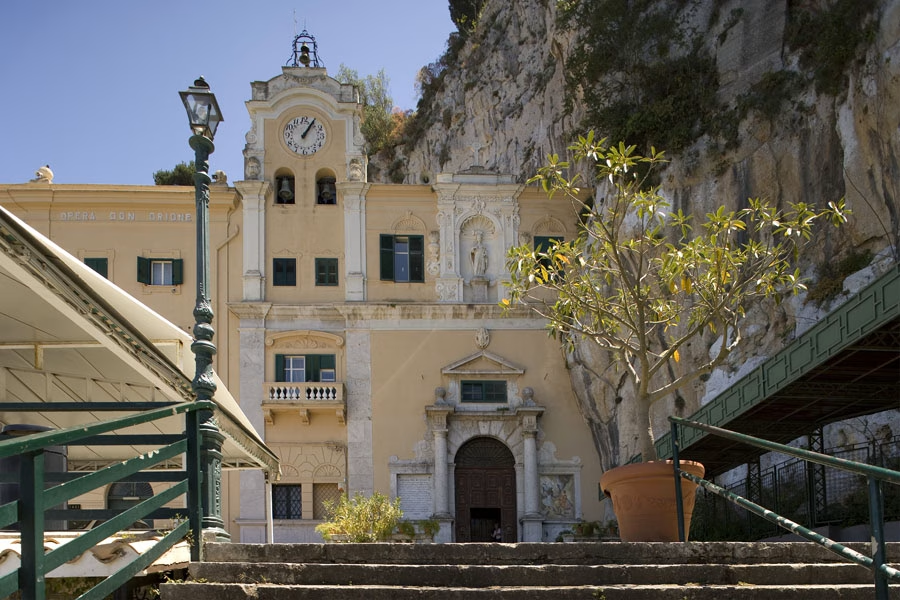
The sanctuary of Santa Rosalia is set into the rock of Monte Pellegrino, joining Palermo’s physical setting to the city’s civic and religious history.
Monte Pellegrino is more than Palermo’s backdrop. The mountain is tied to Santa Rosalia, the city’s patron saint, whose remains were believed to have been found there during the plague of 1624. Palermo’s tradition holds that the procession of her relics through the city helped to end the epidemic. Her sanctuary remains set into the rock above Palermo, while the July Festino turns the Cassaro into a civic and religious stage.
This connection between mountain, saint and city is useful when planning a visit. Monte Pellegrino explains Palermo geographically; Santa Rosalia explains something of its civic identity. Neither needs to become a separate sightseeing day, but both help the city make sense.
PUNIC PANORMOS TO THE NORMAN COURT
From the ancient harbour to Arab-Norman Palermo
Begin at the Salinas Museum
Palermo is sometimes introduced as though it were another Greek city of Sicily. It was not. The permanent settlement was principally Phoenician-Punic, probably established during the seventh century BC. The Greek name Panormos—usually understood as “all harbour”—describes the value of its anchorage, but does not make Palermo a Greek colony.
Ancient remains survive beneath and between later buildings rather than as a single monumental archaeological park. Punic walls can be seen around Palazzo dei Normanni and the old city; a substantial necropolis lies west of the historic centre; Roman houses have been found around Villa Bonanno. The evidence is important, but fragmented.
For that reason, the Antonino Salinas Regional Archaeological Museum is the right starting point. It explains Punic and Roman Palermo while placing the city within the wider archaeology of western Sicily. Its Greek sculptures and architectural fragments often come from sites such as Selinunte, not Palermo itself. That distinction matters: the museum connects Palermo to the island around it without rewriting the city’s own origins.
Islamic Balarm
After Roman, Vandal, Ostrogothic and Byzantine phases, Muslim forces captured Palermo in 831. As Balarm, it became the capital of Islamic Sicily and one of the western Mediterranean’s principal urban centres. Government, maritime trade, crafts and agriculture supported a city extending beyond its older walls. The Kalsa takes its name from the fortified administrative quarter, while systems of irrigation, gardens and water management transformed the surrounding plain.
Very little survives as an intact building from the Islamic period. Palermo’s Islamic inheritance is instead read through street patterns, place names, agricultural knowledge, decorative language and techniques later adopted by the Norman court. It is therefore more accurate to speak of Islamic Palermo and then Arab-Norman Palermo, rather than labelling every domed Norman church as an “Arab building”.
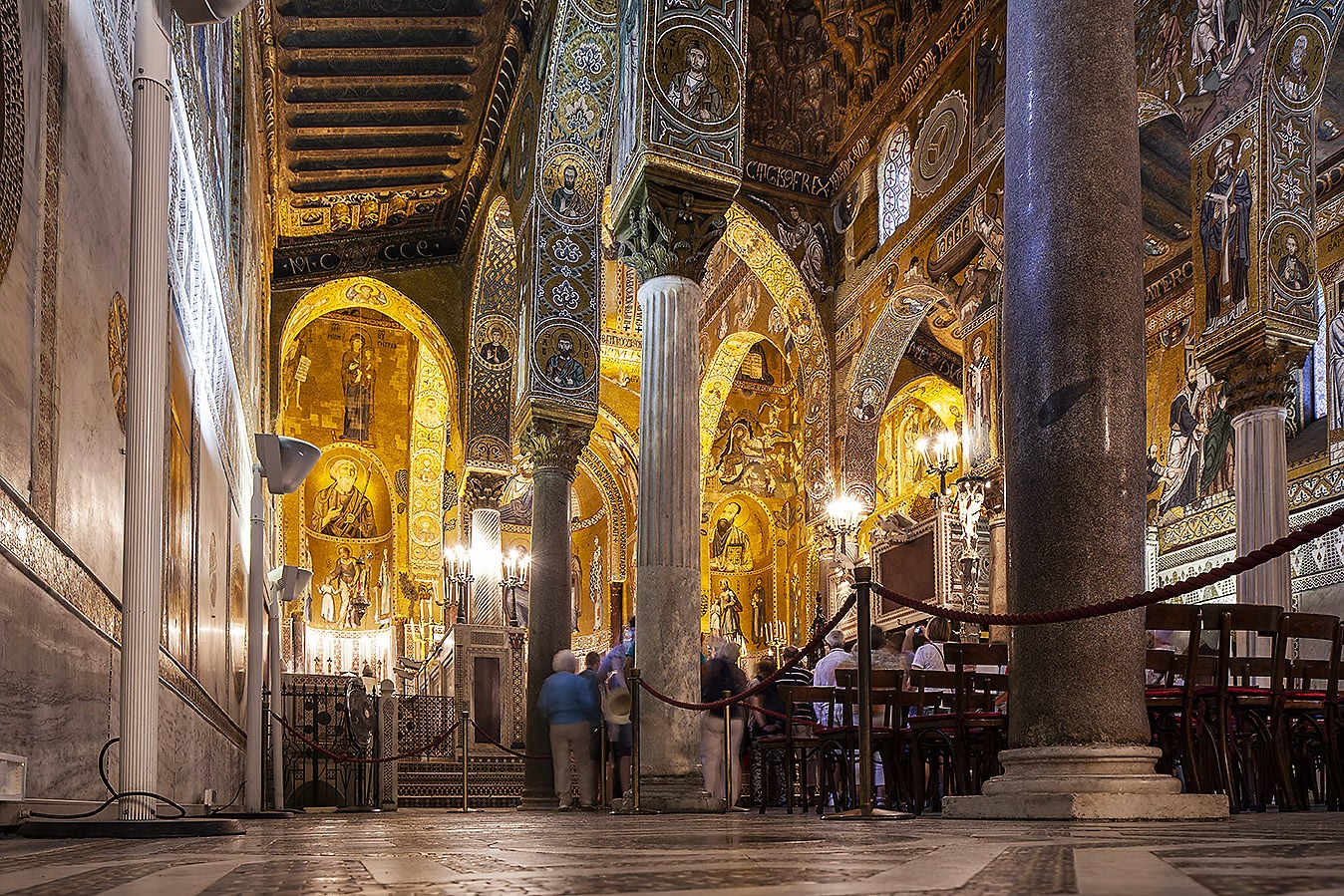
The Cappella Palatina combines Byzantine mosaics, a Latin-Christian royal purpose and an Islamic-derived painted timber ceiling within the Norman palace.
How to read Arab-Norman Palermo
The Normans took Palermo in 1072, but did not discard the knowledge and skilled labour of the city they conquered. When Roger II established the Kingdom of Sicily in 1130, the royal court brought Latin-Christian power together with Byzantine mosaic practice and Islamic-derived forms, engineering and decoration. The result was deliberate court culture, not one simple architectural style.
The clearest expression is inside Palazzo dei Normanni. The palace stands over the upper end of the ancient city, but its essential experience is the Cappella Palatina: gold-ground Byzantine mosaics, marble inlay, Arabic inscriptions and an extraordinary wooden ceiling of painted facets and muqarnas. It is one of the rare places where the ambitions of the Norman kingdom can be understood in a single interior. Visit early if possible and allow time to look upwards; this is not a room to pass through quickly.
From the palace, a useful route follows the Cassaro towards La Martorana and San Cataldo. La Martorana retains major Byzantine mosaics, including the image of Roger II crowned by Christ, although later centuries substantially altered the church. Next door, San Cataldo is powerful for the opposite reason: a restrained interior, an inlaid floor and compact architectural forms beneath its three red domes. San Giovanni degli Eremiti adds another Norman interpretation of Islamic-derived space and form, but should not simply be described as a surviving mosque.
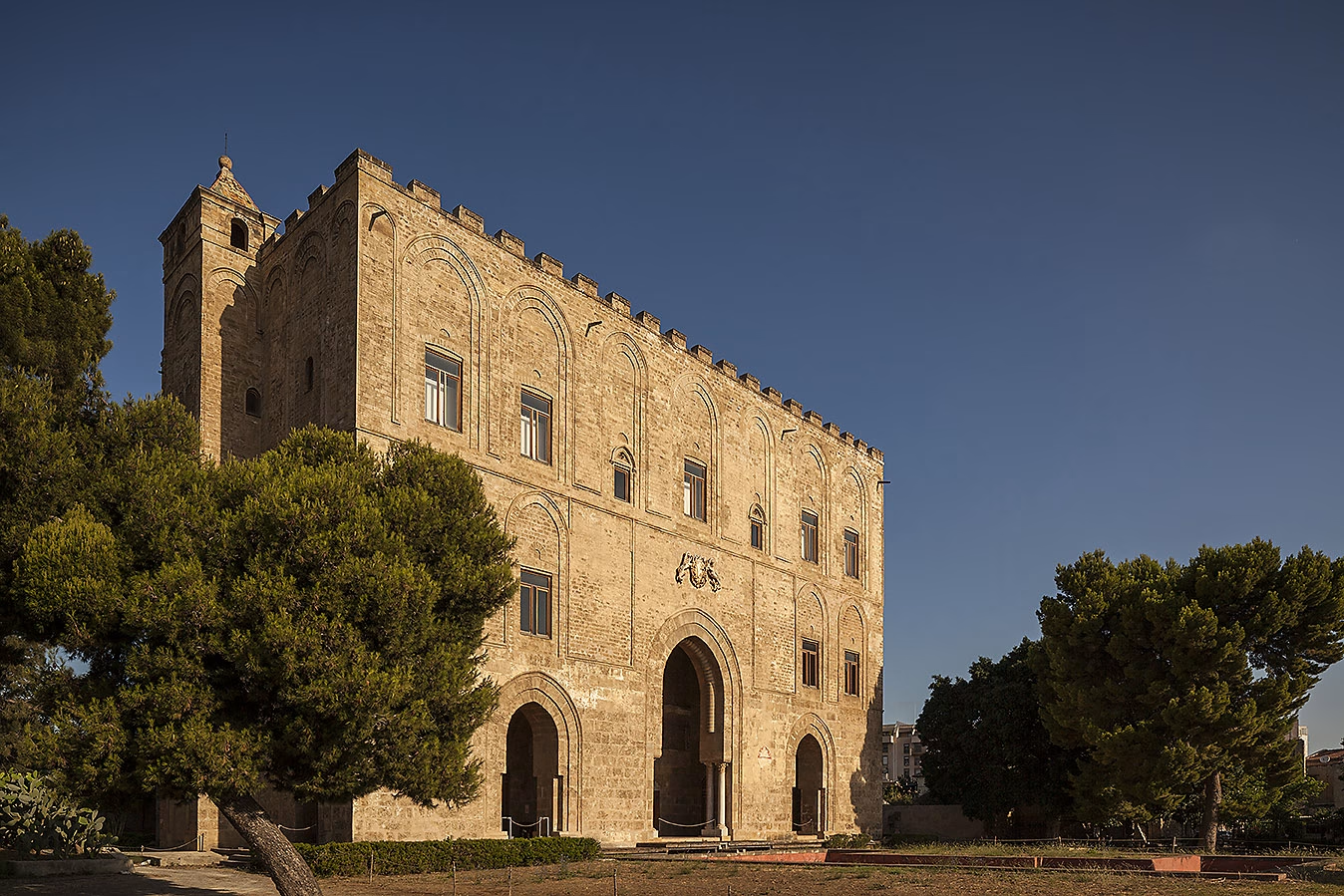
Built for the Norman court in the twelfth century, the Zisa uses Islamic-derived geometry, water and air movement to make a royal palace suited to Palermo’s climate.
The Zisa lies away from the most obvious walking route, but rewards visitors who want to understand how architecture responded to climate. This royal palace was designed around a high central hall, controlled air movement and flowing water. Its purpose becomes clearer when considered against the gardens and productive landscape that once surrounded Palermo.
Monreale beyond the city
Monreale is part of the same UNESCO World Heritage designation, but it is a separate town above the Conca d’Oro, not another central Palermo monument. Its cathedral expands the Norman royal language on a different scale: an immense biblical cycle in mosaic, a powerful image of Christ Pantocrator and a cloister whose carved capitals reward close attention.
Allow a purposeful half-day rather than squeezing Monreale between central sights. The journey also gives a better sense of the plain and mountains that supported Palermo. If time is limited, prioritise the Cappella Palatina for the Norman court and Monreale for the scale of its mosaic programme; do not attempt every Arab-Norman monument as a checklist.
THE CITY IN ITS STREETS
The streets and quarters that hold Palermo together
Cassaro, Via Maqueda and the four districts
The Cassaro is Palermo’s oldest governing line. It runs from Palazzo dei Normanni towards the sea, passing the Cathedral, the historic palaces and the opening towards Porta Felice. At the beginning of the seventeenth century, Via Maqueda cut across it from north to south. Their intersection became Quattro Canti, a theatrical crossroads whose curved façades display seasons, Spanish kings and Palermo’s patron saints.
The crossing helps orient the four historic districts: Albergheria, Monte di Pietà or Capo, Castellammare or Loggia, and Tribunali or Kalsa. These are not sealed heritage zones. Each contains churches, palaces, markets, homes, workshops, neglected buildings and restored spaces. Palermo is best understood by moving between them rather than following one ceremonial street from end to end.
Close to Quattro Canti, Fontana Pretoria fills an entire square with sixteenth-century sculpture made in Tuscany and later transferred to Palermo. Beside it, La Martorana and San Cataldo return the route to the Norman kingdom. Farther up the Cassaro, Palermo Cathedral records a different kind of continuity. Begun in 1185 and repeatedly enlarged or altered, it carries Norman, Gothic, Catalan and later additions rather than presenting a single intact style.
The royal and imperial tombs inside connect Palermo to Roger II and Frederick II.
Palermo Cathedral began in 1185 and was repeatedly altered. Its exterior is a material record of changing rulers and architectural ambitions.
La Kalsa and the Steri
La Kalsa began as the fortified seat of power in Islamic Palermo. Today its appeal lies in the way monumental and everyday Palermo overlap: aristocratic palaces, small churches, workshops, bars, open spaces and buildings still bearing the consequences of war and long neglect.
Palazzo Chiaramonte-Steri gives the district one of its most serious historical visits. Built for the Chiaramonte family in the fourteenth century, it later became the seat of the Spanish Inquisition in Sicily. Prisoners’ drawings and inscriptions survive on the cell walls. Nearby, the roofless church of Santa Maria dello Spasimo has served religious, defensive, medical and cultural purposes across five centuries.
Both places show how Palermo repeatedly reuses buildings after systems of power have disappeared.
A HISTORY THAT NEEDS EXPLANATION
Jewish Palermo
Santa Maria dello Spasimo’s roofless nave embodies La Kalsa’s layered history: religious foundation, defensive use, hospital and, today, cultural space.
Palermo was home to Sicily’s largest Jewish community before the expulsion of 1492. Its history belongs within the city’s main narrative, not as a minor detour. The community participated in trade, medicine, textiles, dyeing and other crafts, and lived for centuries alongside Christian and Muslim populations.
The historic areas of the Meschita and Guzzetta lie around the streets between Via Maqueda and Via Roma. It is more accurate to describe this as a Jewish quarter or giudecca than as a ghetto. Little survives in an immediately recognisable form, so the area benefits from explanation: street names, the Arco della Meschita, later religious buildings and fragments of memory have to be read together.
A knowledgeable guide can make this one of the most revealing parts of central Palermo.
Giacomo Serpotta’s stuccoes transformed Palermo’s oratories into animated Baroque interiors of sculpture, theatre and religious instruction.
Palermo’s Baroque interiors
Palermo’s Baroque character is not confined to large churches and façades. Its most distinctive interiors include the oratories decorated by Giacomo Serpotta around the turn of the eighteenth century.
In places such as Santa Cita, San Lorenzo and the Rosary of San Domenico, white stucco figures project into the room, turning allegory and religious narrative into theatre. Choose one rather than rushing through all three; the quality lies in the detail.
MODERN AMBITION, DESTRUCTION AND RESPONSE
Liberty Palermo, the Mafia and the civic city
The Florio period
In the late nineteenth and early twentieth centuries, Palermo looked beyond the walls of the old city. New avenues, theatres, villas and hotels expressed commercial confidence and international ambition. The Florio family—active in shipping, wine, industry and finance—became central patrons of this world, while architects including Giovan Battista Filippo Basile and his son Ernesto gave Palermo one of Italy’s most distinctive expressions of Liberty, the Italian form of Art Nouveau.
Teatro Politeama marked the expansion around the new city, while Teatro Massimo opened in 1897 with Verdi’s Falstaff. Villino Florio, Villa Igiea and the villas of Mondello show how architecture, decorative art and social display came together.
This was a period of remarkable cultural production, but not universal prosperity. Palermo’s modern history should not be reduced to a Belle Époque fantasy.
Teatro Politeama belongs to Palermo’s nineteenth-century expansion beyond the old city and the new civic axis leading towards Via della Libertà.
War, reconstruction and the Sacco di Palermo
Allied bombing caused grave damage in 1943, especially in the historic centre. Reconstruction was slow and uneven. Some neighbourhoods remained scarred for decades, while post-war growth pushed the city across the Conca d’Oro.
During the 1950s and 1960s, the period remembered as the Sacco di Palermo replaced citrus gardens and villas with speculative construction. The destruction was not simply poor architectural taste. Planning decisions, political patronage, building interests and Mafia power intersected. Palermo’s landscape changed rapidly, and the relationship between the city and its fertile plain was severely weakened.
Mafia violence and Palermo’s response
The Mafia is part of Palermo’s history, but it should not be treated as entertainment or allowed to define the whole city. Cosa Nostra developed through control of land, protection, commerce, public contracts and political relationships. The post-war building boom was one particularly damaging arena.
Judges, police officers, journalists, politicians, trade unionists, priests, business owners and citizens paid with their lives for opposing it. The assassinations of judges Giovanni Falcone at Capaci and Paolo Borsellino in Via D’Amelio in 1992 brought enormous public anger onto Palermo’s streets.
Their work belonged to a longer institutional struggle, and the civic reaction continued through education, public commemoration, anti-racket initiatives and the recovery of property confiscated from the Mafia.
WHY THIS HISTORY MATTERS
Palermo’s damaged buildings, Liberty villas, post-war suburbs and anti-Mafia memorials are not separate stories. Together they explain how political power has shaped the city—and how Palermo has repeatedly argued over the kind of city it wants to become.
FOOD AS SOCIAL HISTORY
What Palermo’s markets and food reveal
Palermo’s markets are often described as unchanged survivals from Arab rule. Their long histories matter, but so does change. Stalls move, neighbourhoods evolve and the balance between food retail, street eating and nightlife shifts. Visit them as living commercial spaces rather than open-air museums.
Ballarò
Ballarò extends through Albergheria and remains Palermo’s most substantial working market. Fruit, vegetables, fish, meat, household goods and prepared food fill the streets, while the calls of vendors remain part of its soundscape.
It is energetic, untidy and closely connected to the neighbourhood around it. Morning through lunchtime is the most useful period for seeing the market at work.
Ballarò remains a working food market in Albergheria; its commercial and neighbourhood roles matter more than the idea of an unchanged “Arab market”.
Capo
Capo threads through narrow streets behind Teatro Massimo. It is more compact than Ballarò and remains strongly associated with food shopping, fish and produce. It fits naturally into a walking day linking the theatre, market and upper historic centre.
Vucciria
Vucciria was once one of Palermo’s defining food markets, but its retail role has greatly reduced. Piazza Caracciolo and its surrounding streets become increasingly social as the day progresses, with street food, drinks, music and nightlife. Go for late-afternoon or evening atmosphere, not expecting the same working market as Ballarò or Capo.
Fish and seafood remain part of Palermo’s market economy: these are working places of shopping and supply, not simply settings for street-food tourism.
What to eat—and what it explains
Palermo’s street food is rooted in labour, thrift and the use of ingredients that wealthier kitchens discarded. Panelle are chickpea fritters, often served in bread; pani câ meusa fills a roll with spleen and lung; and stigghiola places seasoned intestines over charcoal. These are specific foods with particular textures and histories, not compulsory challenges. Try what interests you.
Sfincione is Palermo’s soft, thick street pizza, usually topped with tomato, onion, anchovy, cheese and breadcrumbs. The city calls its filled rice balls arancine, using the feminine form. Market stalls and fry shops sell familiar fillings such as meat ragù or butter, ham and cheese, although contemporary versions range more widely.
Do not stop at street food. Pasta con le sarde brings together sardines, wild fennel, saffron, raisins and pine nuts in a dish shaped by the sea, landscape and Sicily’s long Mediterranean connections.
Caponata, seafood, vegetable dishes, baked pasta and seasonal preparations belong to the wider table. Cassata, cannoli and summer gelo di mellone show how convents, celebration and the availability of sugar influenced Palermo’s sweets.
THE CITY BY THE SEA
Mondello and Palermo’s cultural sea break
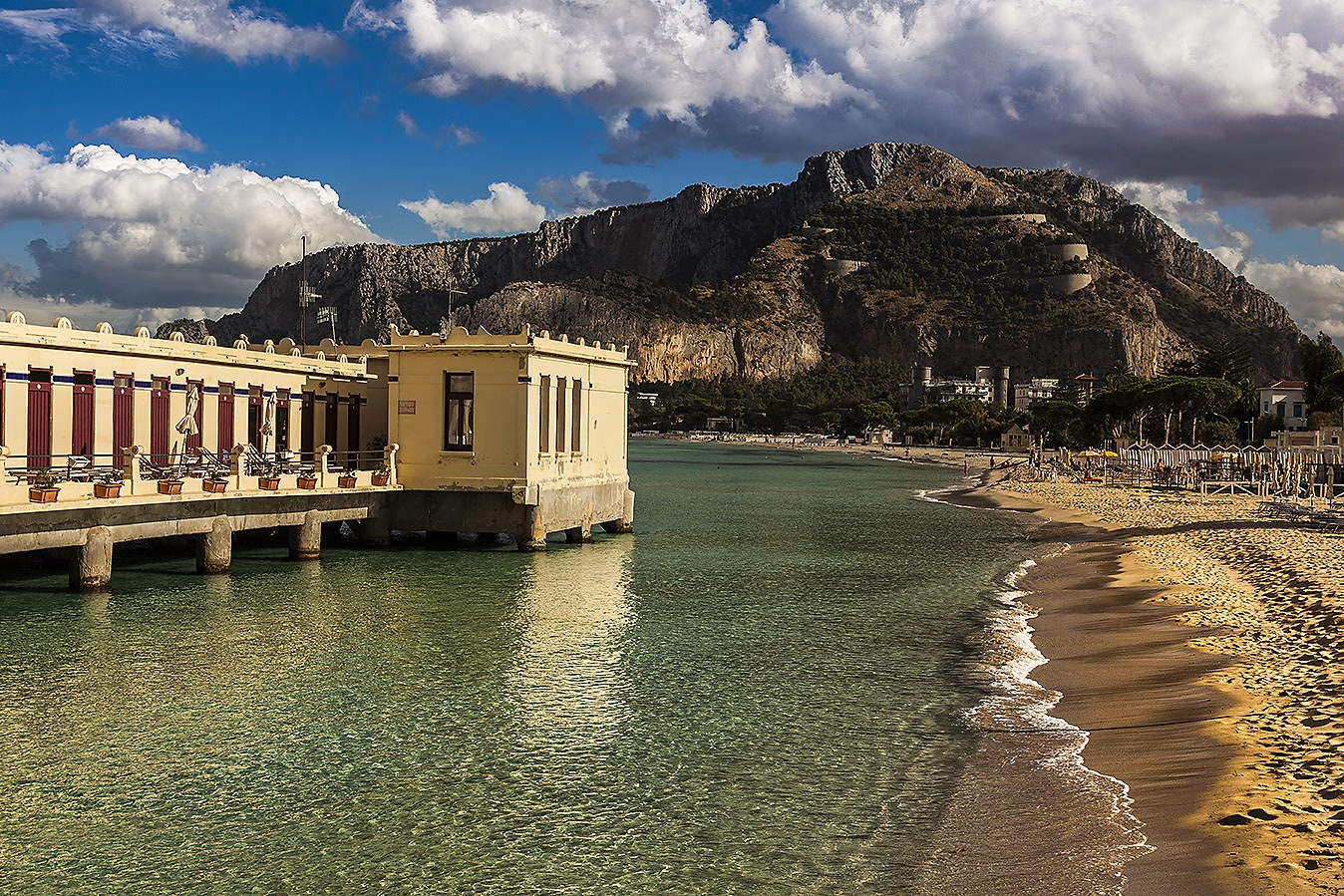
Mondello is not simply Palermo’s nearest convenient beach. Its bay sits between Monte Pellegrino and Monte Gallo, opening the city towards clear, shallow water and a broad arc of sand. The old fishing settlement expanded after marshland was drained and a planned resort developed during the early twentieth century.
Liberty villas, gardens and the historic bathing establishment gave Mondello an architectural identity linked to Palermo’s period of outward-looking confidence. Some buildings are better preserved than others, and modern beach life can obscure the original plan, but the resort remains part of Palermo’s social and architectural history.
Mondello lies between Monte Pellegrino and Monte Gallo; its villas and historic bathing architecture belong to Palermo’s early twentieth-century Liberty story.
Visiting or staying in Mondello
For most first visits, the strongest arrangement is to stay centrally and give Mondello a purposeful half-day or full day. This keeps Palermo’s monuments, markets and evening streets within walking distance while preserving the beach as a change of rhythm. Local buses and taxis connect the two, but summer traffic can make journey times unpredictable.
Staying in Mondello works differently. It suits travellers for whom morning swims, a beach rhythm and evenings by the bay matter more than walking to a museum or church. Central Palermo then becomes the excursion. This can work very well during a longer stay, but it is less convincing for a short, culture-heavy city break.
Beach concessions, services and public-access arrangements can change from one season to another. In July and August, expect heat, crowds, heavier traffic and pressure on parking and facilities. We prefer to check the current position when planning the holiday rather than promise a particular lido far in advance.
Choosing the right Palermo base
01
Historic centre
Best for a first visit and for travellers who want the Arab-Norman monuments, Cassaro, markets and city restaurants close at hand.
Best for travellers drawn to Palermo’s layered streets, restored palaces, smaller cultural spaces and evening atmosphere while remaining within the central walking area.
A workable minimum for the principal city monuments, one market and either Monreale or Mondello.
4 nights
The strongest first stay: enough time for the Norman court, historic quarters, food, Monreale and a meaningful visit to the sea.
5+ nights
Appropriate for slower travel, stronger interests in art and history, or a deliberate balance between city and beach.
Palermo as the beginning of a longer journey
Palermo works naturally at the beginning of a route through western Sicily. A car can be collected only when leaving the city for Erice, Trapani, Marsala, Menfi, San Vito Lo Capo and the Zingaro coast. This avoids driving and paying for parking while the car is unnecessary.
Travellers who prefer not to drive can instead use rail, private transfers and ferries. The
Palermo, Aeolian Islands and Taormina itinerary
joins a cultural city, island landscapes and eastern Sicily without treating every transfer as lost time.
Palermo travel questions
How many days do you need in Palermo?
Three nights are a workable minimum. Four nights are preferable if you want to understand the city rather than collect its principal monuments: one day for the royal and Arab-Norman city, one for the quarters and markets, and time for Monreale and Mondello. Add another night for a slower pace or stronger beach emphasis.
Is it better to stay in central Palermo or Mondello?
Stay centrally for a first visit, a short break or a culture-led itinerary. Choose Mondello when the sea should set the daily rhythm and you are comfortable treating central Palermo as an excursion. La Kalsa provides an attractive central alternative for travellers who prefer a more atmospheric neighbourhood base.
Do you need a car in Palermo?
No. A car is more hindrance than help in the historic centre because of traffic, restricted zones and parking. Walk, use taxis or local transport, and collect a hire car only when leaving for western Sicily or the countryside.
Can Monreale be visited from Palermo?
Yes. Monreale is a separate hill town but an easy purposeful excursion. Allow roughly half a day for the cathedral, cloister and journey. A private transfer or guided visit gives the cleanest timing; public transport can work when the day remains flexible.
Which Palermo market should you visit?
Choose Ballarò for the strongest working-market experience and Capo for a more compact food market that fits easily into a central walk. Visit Vucciria later in the day for social atmosphere, street eating and nightlife rather than expecting a traditional produce market.
Is a guided visit worthwhile?
Yes, when the guide adds interpretation. Palermo’s ancient remains, Jewish quarter, Arab-Norman synthesis, markets and anti-Mafia history are easily oversimplified. One well-chosen guided visit can provide the framework; the rest of the stay should retain unstructured time to walk and observe.
Should you visit the No Mafia Memorial?
Yes, especially if your knowledge of Mafia history comes mainly from films. The Memorial explains violence, political and economic relationships, institutional resistance and civic response through documentation. Check its official visiting page because opening arrangements may change.
Is Palermo suitable for a cultural sea break?
Very much so, provided the stay is not too short. Palermo supplies the depth of a major historical city; Mondello adds a genuine seaside chapter with its own geography and Liberty architecture. Four nights usually give both settings enough room to complement rather than compete with each other.
When is the best time to visit Palermo?
April to June and September to October generally provide the best balance for walking and cultural visits. The sea becomes more relevant from late spring into autumn. July and August are hot and busy, particularly at Mondello; winter suits a city-led stay focused on food, history and quieter streets.
Palermo works best when its history, markets, food and coastline are given enough time to connect. It can stand alone as one of Italy’s finest cultural sea breaks or form the opening chapter of a wider Sicilian journey.