Things to Do in Lucca: Walls, Towers & Quiet Tuscan Charm

Lucca is one of those rare Italian cities that does not need to shout. It speaks softly: through its Renaissance walls, tree-topped towers, discreet palaces and the easy rhythm of people crossing the piazzas on bicycles. If you are wondering about the best things to do in Lucca, the answer lies as much in this everyday atmosphere as in any single monument.

This Lucca travel guide is for the cultured traveller who prefers atmosphere to spectacle. Visitors often talk about Lucca’s beauty; those who stay long enough talk about its intelligence – a city that has preserved its shape, its calm and its character without turning itself into a stage set.

Panoramic view of Lucca’s terracotta rooftops, churches and towers with autumn trees and hills in the background

Lucca from above: a sweep of terracotta roofs, church towers and autumn trees framed by the soft hills around the city.

Things to Do in Lucca: A City That Reinvents Itself Without Losing Its Soul

Lucca has learnt to renew itself – from comics festivals to concerts – without sacrificing its calm, intelligent everyday rhythm.

Lucca has learnt how to reinvent itself without losing its core identity. Each autumn the city hosts Lucca Comics & Games, one of Europe’s most important comics and gaming festivals, filling streets and squares with colour, illustration and cosplay.

On an ordinary day, though, you find a measured, very Tuscan city: Puccini’s birthplace, a grid of medieval lanes, artisan workshops, small theatres and family-run cafés that still know most of their customers by name. Walk its streets and you sense a place that understands who it is: neither provincial nor showy, but cultivated, self-possessed and quietly curious about the world.

Piazza dell’Anfiteatro – An Oval Embrace

The old Roman arena now holds one of Tuscany’s most distinctive squares, an oval of façades that turns everyday life into a natural stage.

No other square in Tuscany feels quite like Piazza dell’Anfiteatro. It sits exactly where the Roman amphitheatre once stood, and the curve of the arena still shapes the buildings that surround it. You enter through narrow vaulted passages and suddenly find yourself in an ellipse of warm façades, balconies, cafés and tables set under sunshades.

In the morning it is almost contemplative; at aperitivo time it becomes Lucca at its most sociable – a natural theatre where the performance is simply people enjoying being there.

Piazza dell’Anfiteatro in Lucca at dusk with cafés and warm lights under a deep blue sky

Piazza dell’Anfiteatro at dusk, the curve of the old Roman arena now wrapped with cafés and warm lights – Lucca at its most sociable.

Towers with Trees and Towers with Time

Lucca’s skyline is gentle but distinctive. Above the roofs rises the Torre Guinigi, crowned with a small hanging wood of evergreen oaks. Climbing it is like climbing into a garden in the sky; from the top you look out over terracotta tiles and campanili, with the outline of the Apuan Alps and Apennines in the distance.

Nearby, the Torre delle Ore (Clock Tower) still houses an 18th-century mechanical clock. Its slow, regular workings feel perfectly matched to the city’s tempo, marking time for a place that is in no hurry to rush.

Torre Guinigi in Lucca, a medieval brick tower topped with holm oak trees rising above rooftops and autumn trees

The Torre Guinigi, Lucca’s most distinctive tower, crowned with a tiny rooftop grove of holm oaks above the city’s terracotta roofs and autumn trees.

Torre delle Ore clock tower in Lucca framed by narrow shadowed alleys

The Torre delle Ore, Lucca’s historic clock tower, catches the sunlight at the end of a narrow alley, marking time above the city’s quiet streets.

The Renaissance Walls – Tuscany’s Most Civilised Walk

Lucca’s walls are not a monument to look at but a tree-lined park to live on, used daily by walkers, joggers and cyclists.

Lucca’s 16th-century walls are its most famous feature – and its most loved public space. Atop the ramparts runs a 4.3 km tree-lined promenade, broad enough for walkers, cyclists, joggers, families and dogs to share the space without jostling. Locals use it as their everyday park; visitors quickly realise it is the best way to understand Lucca’s shape and scale.

Come in the early evening, when the light softens and the city begins its passeggiata: you see churches and towers from new angles, hear music drifting up from below and catch glimpses of gardens hidden behind palazzo walls.

Joggers on Lucca’s tree-lined Renaissance walls in late afternoon light
Wide promenade on Lucca’s city walls with walkers beneath rows of plane trees
Group of women relaxing on a bench under trees along Lucca’s walls

Life on Lucca’s Renaissance walls: a broad, tree-lined promenade where locals walk, jog and linger on benches above the city’s rooftops.

Orto Botanico di Lucca – A Small, Cultivated World

A compact nineteenth-century garden where Lucca’s scientific past, rare plants and pockets of shade create a quiet pause from sightseeing.

Just inside the walls lies one of Lucca’s most discreet treasures: the Orto Botanico, a pocket-sized botanical garden founded in 1820. Rather than a grand showpiece, it is a calm, intelligent garden designed for study and quiet pleasure.

History in a nutshell

✸ Founded in 1820 by Maria Luisa of Bourbon, Duchess of Lucca, as the university’s scientific garden.

✸ Once part of a wider complex with observatory, physics laboratory and anatomy theatre.

✸ Historic layout – Montagnola hill, arboretum and lagoon – still broadly follows the original plan.

✸ Today ranks among Tuscany’s historic botanical gardens alongside Pisa, Florence and Siena.

Where it is & how to enter

✸ Visitor entrance and ticket office: Casermetta San Regolo, Via delle Mura Urbane 5, directly on the walls.

✸About 5–10 minutes’ walk from the historic centre: climb onto the walls and follow signs to San Regolo.

✸Opening hours vary by season – check the official website before visiting.

✸ Combined ticket available with the Guinigi Tower and the Clock Tower.

What you will find inside

✸ Teaching garden with beds laid out for learning and plant classification.

✸ Rhododendron and camellia collections, particularly lovely in late winter and early spring.

✸ Pond and peat bog with aquatic and wetland plants.

✸ Montagnola hill and arboretum with mature trees and views towards the walls.

✸ Small “Cesare Bicchi” museum with historic herbarium sheets and teaching materials.

✸ Working greenhouses that protect more delicate species.

Season by season

✸ Late winter / early spring: camellias and early bulbs.

✸ Spring: fresh foliage, blossom, soft light.

✸ Summer: deep shade, structure, cool corners.

✸ Autumn: fungi, seed heads, warm colours.

A key annual highlight is “Murabilia” (early September), one of Italy’s main gardening fairs, which turns the nearby stretch of walls into a festival of plants, books and botanical art, with the garden fully included in the programme.

Close-up of a pale pink camellia flower in full bloom at Lucca’s Botanical Garden

A perfectly layered pink camellia in the Orto Botanico di Lucca, one of the garden’s quiet winter and early-spring highlights.

Make Lucca Your Base – Stay at Hotel Ilaria


Prefer to stay inside the walls rather than commute in for the day? Hotel Ilaria sits between the medieval streets and the green ring of bastions – historic character with the comfort of a modern 4★ city hotel.


Direct access to Lucca’s Renaissance walls for walks and runs.

Complimentary bicycles for exploring lanes, gardens and cafés.

Leafy terrace with jacuzzi and quiet, well-appointed rooms.


See how a stay here could anchor your holiday:

discover our tailor-made breaks at Hotel Ilaria

or ask us to weave Lucca into a wider Tuscany itinerary.

Churches Without Bombast

Upper façade of San Michele in Foro in Lucca, with the statue of the Archangel Michael against a deep blue sky

The ornate marble façade of San Michele in Foro, crowned by the bronze Archangel Michael, one of Lucca’s most recognisable silhouettes against the Tuscan sky.

Lucca is sometimes called the “city of a hundred churches”, and while the number is poetic rather than precise, the effect is real.

San Michele in Foro stands on the site of the Roman forum, its façade a fantasy of carved columns and arcades, crowned by a statue of the Archangel Michael that seems almost close enough to touch from neighbouring windows.

San Frediano is marked by its luminous Byzantine-style mosaic, glittering above the square like a fragment of an earlier Mediterranean world.

San Martino, the cathedral, shelters the Volto Santo, an 8th-century wooden crucifix that has drawn pilgrims for centuries and still shapes the city’s religious calendar.

San Paolino, dedicated to Lucca’s patron saint, feels more restrained at first glance, but step inside and you find a spacious, harmonious interior with strong lines, side chapels and paintings that quietly underline how deeply the cult of San Paolino is woven into the city’s identity.

None of these churches is presented as a museum piece; they are simply part of the city’s fabric, places where life and liturgy continue side by side, and where beauty is something you coexist with rather than merely admire.

Interior of San Paolino church in Lucca with side chapels and Puccini family private chapel

Inside San Paolino church in Lucca, where quiet arches, painted chapels and the Puccini family’s private chapel reflect the city’s enduring devotion.

Palazzo Pfanner – Where Baroque Grace Meets Real Life

A Palace at the Edge of the Walls

Pressed gently against the northern stretch of Lucca’s walls, Palazzo Pfanner is one of the city’s most evocative addresses. It began life in the late 17th century as the residence of powerful merchant families, who enlarged it with a grand staircase, frescoed salon and formal garden. You feel at once that this was a house built to be seen.

A Garden That Feels Like a Stage

Step outside and you are in a textbook Baroque garden: clipped box hedges, gravel paths, citrus trees in terracotta pots, a central fountain and a ring of statues representing gods, virtues and the seasons. Beyond the balustrade rise the rooftops and the bell-tower of San Frediano, so the whole scene reads almost like a painted backdrop. It is one of the most photogenic viewpoints in Lucca, yet never feels crowded or over-choreographed.

From Beer to Scalpels – An Unexpected Story

In the 19th century the palace took a more unexpected turn. The Austrian brewer Felix Pfanner installed one of the first breweries in the Duchy of Lucca here, turning the garden into an elegant beer garden long before beer gardens were fashionable. His son, Pietro Pfanner, became a renowned surgeon and later mayor of Lucca; his collection of medical instruments and documents is still displayed in some of the rooms, adding an intriguing scientific layer to the visit.

Cinema, Culture and Why It Matters

Today, Palazzo Pfanner is more than a handsome backdrop. Its façades and garden have appeared in several films, making it one of Lucca’s most recognisable cinematic faces, but what really stays with you is the sense of overlapping lives: noble families, brewers, doctors, modern visitors drifting along the same gravel paths.

For the cultured traveller, it offers a concentrated version of Lucca itself – aristocratic but human, elegant yet practical, and always slightly more interesting the longer you look.

Entrance courtyard of Palazzo Pfanner in Lucca with statues, potted palms and arcaded façades

The elegant courtyard of Palazzo Pfanner, where statues, palms and arcaded galleries introduce one of Lucca’s most atmospheric historic palaces.

Baroque statues and fountain in the garden of Palazzo Pfanner in Lucca with a medieval tower in the background

Baroque statues and a fountain in the garden of Palazzo Pfanner, with Lucca’s medieval tower rising beyond the palms and roses.

Frescoed grand hall inside Palazzo Pfanner in Lucca with red carpet, chandeliers and display cases

The frescoed grand hall of Palazzo Pfanner, where painted columns, chandeliers and a red carpet evoke the palace’s aristocratic past in the heart of Lucca.

Puccini’s Lucca – A City with Its Own Soundtrack

Giacomo Puccini was born in Lucca, and the city has not forgotten. You can visit his birth house, now a small museum with scores, letters and personal objects, and you can hear his music most evenings at the “Puccini e la sua Lucca” concerts held in the church of San Giovanni.

These recitals are intimate, direct and wonderfully atmospheric – an hour where the city’s stone, its acoustic and Puccini’s melodies meet.

Weave the Turandot Centenary into Your Lucca Holiday


In 2026, Puccini’s world returns centre stage with the Turandot centenary at the Puccini Festival in Torre del Lago.
It is a rare chance to combine time inside Lucca’s walls with an evening (or two) on the lakeside, hearing his music where it was conceived.


Rather than a fixed package, we prefer to weave the festival into a tailor-made holiday – choosing the right performance dates,
pairing Lucca with the Versilia coast if you wish, and arranging tickets and logistics to match how you like to travel.


Find out more about the centenary performances and how they can fit into your plans:


Turandot Centenary – Lucca & Versilia
.

Statue of composer Giacomo Puccini in Lucca with musical symbols and a passer-by in the square

The statue of Giacomo Puccini in Lucca, paired with playful musical symbols – a reminder that the city still moves to the composer’s rhythm.

Shopping & Tasting – Everyday Pleasures with Deep Roots

Historic bakeries, botteghe and ateliers turn a simple stroll into a sequence of tastings, conversations and small discoveries.

Lucca does not put on a show when it comes to food; it simply carries on doing what it has always done well. Around Piazza San Michele and in the streets that radiate from it, historic bakeries, pasticcerie and old-fashioned food shops keep local traditions alive. One of the sweetest is the story of Lucca’s signature cake, the buccellato, baked since the 19th century by the same family.

Shopping & Tasting · Buccellato at Taddeucci

A few steps from Piazza San Michele, Pasticceria Taddeucci has guarded the recipe for Lucca’s most emblematic sweet since 1881: the buccellato, a soft loaf of flour, sugar, anise and raisins. Locals eat it still warm in slices – on its own, with butter and jam, or alongside cured meats. After a day or two the “filino” is dipped in milk, fried in a pan and sprinkled with sugar: nothing wasted, and the flavour becomes even more indulgent.

Not far away, historic ovens such as Forno a Vapore Amedeo Giusti and Forno Casali have been baking bread and focaccia for over a century. Queues outside at almost any time of day say everything about their role in local life.

Shopping & Tasting · Historic Ovens of Lucca

Between Via Santa Lucia and Via Guinigi, bakeries such as Amedeo Giusti and Forno Casali have been part of Lucca’s daily rhythm for generations. People queue for focaccia and everyday loaves, but also for the small rituals that go with them: a quick chat, a recommendation, a sense that in this city the forno is still a neighbourhood institution rather than a trend.

Interior of a historic pastry and delicatessen shop in Lucca with glass counters of cakes and wooden shelves of jars and bottles

A traditional Lucca pastry and delicatessen shop, where glass counters of cakes and polished wooden shelves overflow with jars, bottles and local specialities.

Opposite Giusti, the Antica Bottega di Prospero still sells cereals, beans, flours and DOP olive oil loose, as it always has. The pleasure here is also in the pace: the current owner, third generation of the family, serves each customer without hurry and with plenty of cooking advice.

From food you can glide naturally into Lucca’s artisan side – weaving, fashion, design – which reveals another layer of the city.

Shopping & Tasting · Old-World Pantry & Contemporary Ateliers

At the Antica Bottega di Prospero, cereals, pulses, flours and Lucchese DOP olive oil are still sold loose, with each customer served calmly and personally. A short walk away, ateliers such as those of artist Emy Petrini, the historic Atelier Ricci and the looms of La Tela di Penelope reveal another Lucca: a city of hands that weave, stitch and shape materials into quietly beautiful objects, keeping old trades very much alive.

Taken together, these places turn a simple wander into a sequence of tastings and encounters – a kind of informal, edible city tour woven through back streets and small squares.

The Villas of Lucca – Aristocratic Gardens on the Edge of Town

Beyond the walls, the countryside holds a necklace of historic villas built between the Renaissance and the 18th century by Lucchese silk merchants and noble families. Villa Reale, Villa Torrigiani, Villa Oliva and others open their gardens and, in some cases, interiors to visitors.

Expect gravel avenues, clipped hedges, citrus orangeries, water features and long perspectives framed by cypress trees – an elegant counterpoint to the compact city within the walls, and a rewarding half-day excursion from any Lucca base.

View from the loggia of Villa Oliva near Lucca onto a formal lawn, hedges and fountain

Looking out from the loggia of Villa Oliva near Lucca onto a quiet formal garden of clipped hedges, potted shrubs and a central fountain. Built for a Lucchese noble family and later refined during the Renaissance, the villa became known for its elegant gardens and water features, a classic example of the countryside retreats that once showcased the wealth and taste of Lucca’s aristocracy.

Day Trips – A Different Face of Northern Tuscany

From Lucca you can reach big monuments, beaches and hill villages in under an hour, without ever losing the city as your base.

Pisa – less than 30 minutes away by train for the Piazza dei Miracoli and the Leaning Tower.

Garfagnana – a valley of chestnut woods, stone villages, walking trails and very honest cooking.

Montecarlo – a hilltop wine village with views and tastings.

Viareggio and the Versilia coast – Liberty-style façades, long sandy beaches and excellent seafood.

Bagni di Lucca – historic thermal springs once favoured by European nobility.

You can keep days light and local, or build a more active programme with walking, cycling and country trattorie – ExpertoItaly can help you shape the balance.

Pisa’s Cathedral and Leaning Tower on the Piazza dei Miracoli under a clear blue sky

Pisa’s Cathedral and Leaning Tower on the Piazza dei Miracoli – an easy train ride and lively contrast to Lucca’s quieter rhythm.

Liberty-style seafront promenade in Viareggio with shops, cafés and people strolling on a sunny day

Liberty façades and cafés on Viareggio’s seafront, an easy day trip from Lucca for sea air, gelato and effortless people-watching.

Why Lucca Stays with You

In the end, what distinguishes Lucca is not one landmark but a way of being. It is in the way the walls are used as a park, not a postcard; in the fact that bakeries and botteghe are still family-run; in the mix of Puccini arias, comic-book festivals, botanical gardens and artisan studios that all feel entirely at home here.

For the traveller who enjoys cities that reveal themselves gradually – through repeated walks, familiar corners and small discoveries – Lucca is quietly, enduringly rewarding. It does not dazzle you; it settles into you.

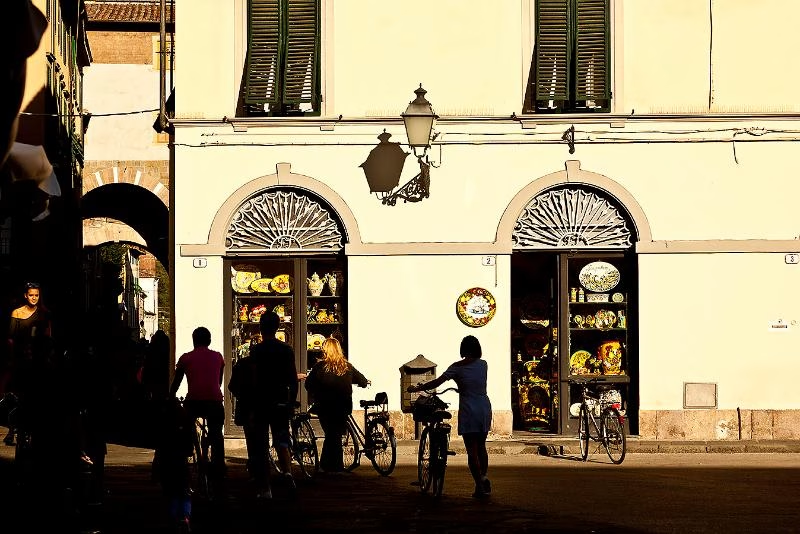
People with bicycles in evening light outside a ceramics shop in Lucca

Evening light in Lucca, as cyclists pause outside a ceramics shop and the city slips effortlessly from daytime errands into its unhurried night.

Is Lucca a good base in Tuscany?

Yes. Lucca is an excellent base if you want a calm historic centre with easy access to other parts of Tuscany. From here you can enjoy many of the best things to do in Lucca itself – walls, churches, gardens and concerts – and still reach Pisa, the Versilia coast and nearby hill villages in under an hour.

How many days do you need in Lucca?

For a first visit, we suggest at least two or three nights. That gives you time to walk the walls, see the main churches and towers, visit the Orto Botanico and enjoy an evening Puccini concert without rushing. With four or five nights you can add relaxed day trips to Pisa, the Versilia coast, the villas around Lucca or the Garfagnana.

Do you need a car in Lucca?

No. Lucca works very well as a car-free base. The historic centre is compact and walkable, and bicycles are ideal for getting around. Trains and local buses connect Lucca with Pisa, Viareggio, Florence and other nearby towns, so many travellers skip the car entirely or hire one only for a day in the hills.

What are the best day trips from Lucca?

Popular day trips include Pisa for the Piazza dei Miracoli, Viareggio and the Versilia coast for sea air and Liberty architecture, and the Garfagnana for walks, chestnut woods and simple country cooking. You can also visit the historic villas around Lucca or the wine village of Montecarlo for tastings and views.

Plan Your Lucca Holiday with ExpertoItaly


If Lucca’s walls, gardens and quiet elegance sound like your kind of Tuscany, we can help you turn this guide into
a perfectly paced itinerary. From handpicked boutique hotels to rail tickets, private transfers, Puccini evenings
and gentle day trips into the countryside, every element is tailored to how you like to travel.


Tell us how long you wish to stay, whether you prefer to travel car-free or with a hire car, and what you most want
from your time in Lucca – we will design the rest around you.


Contact ExpertoItaly to start planning your Lucca holiday.

Tags :