The Siracusa Greek theatre festival ran from 8 May to 28 June 2026, bringing Antigone, Alcesti, I Persiani and Iliade back to the ancient Greek Theatre carved into the hillside above the Neapolis archaeological park.


The 2026 season explored a question shared by all four works: what happens when power overreaches, when law hardens against conscience, and when the boundary between life and death is stretched too far?
This article preserves the 2026 programme and its cultural background. For a future visit, INDA’s published 2027 season runs from 7 May to 25 June, with a separate student event in April. See the official 2027 calendar, then contact us to plan your Siracusa stay around a performance.

The Greek Theatre of Siracusa, carved into the Temenite hill and opening towards the Neapolis park and the sea.
Sit in the vast stone cavea carved into the Temenite hill, within the Archaeological Park of Neapolis and the UNESCO-listed landscape of Siracusa and Pantalica.
On a good evening there is a warm breeze from the harbour, the light drops behind the city, and a few thousand people fall silent together as stories more than two thousand years old start to sound alarmingly current.
The venue: the Greek Theatre of Siracusa
Open-air theatre within the Parco Archeologico della Neapolis, reached from Ortigia by taxi or local bus. Allow time for traffic and the walk to your seat.
One of the largest surviving theatres of the Greek world, with remarkable acoustics and a wide view over Siracusa.
Set alongside the Roman amphitheatre, the Ara di Ierone and the famous “Ear of Dionysius”, so you can combine a daytime visit to the park with an evening performance.
Modern productions make striking use of the open-air setting, with voices, movement and changing evening light bringing the ancient stories to life.
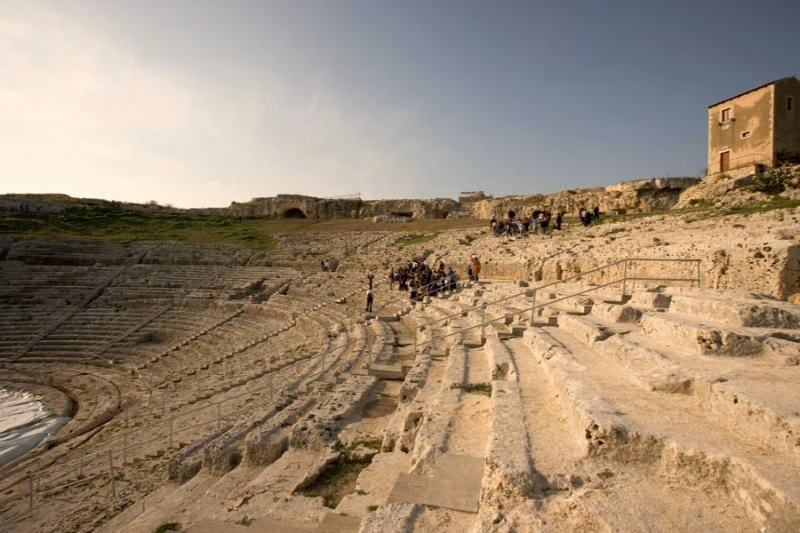
Stone tiers, late light and the first spectators gathering – this is where Siracusa’s 2026 Greek theatre festival comes to life.
The four productions in 2026
The 2026 season explored “Sconfinamenti” – boundary-crossings.
Greek drama returns again and again to the same question:
What happens when you step beyond the limits – human, political or divine – that are meant to keep the world in balance?
Each work touches a different border:
Power and hubris in I Persiani, where Xerxes tries to command land and sea and pays the price.
Law and conscience in Antigone, where a young woman decides that state decrees cannot overrule unwritten moral law.
Life and death in Alcesti, where a king is allowed to escape his fate if someone else will die in his place.
Genres and languages in Iliade, which blends theatre, dance and music to retell Homer for a modern audience.
It is an elegant thread that links the plays to each other – and to today’s arguments about borders, identity and what we are prepared to sacrifice.
Season
8 May – 28 June 2026
Start times
May performances: 19:00
June performances: 19:30
Running times vary by production; check the information for your chosen performance.
Antigone – Sophocles
May: 9, 11, 13, 15, 17, 18, 20, 22, 24, 26, 28, 30
June: 1, 3, 5
Thebes has torn itself apart in civil war. Eteocles and Polyneices, sons of Oedipus, have killed each other in battle. Creon, now king, decrees that one brother will be honoured with full burial, while the “traitor” must be left unburied outside the city walls.
Their sister Antigone refuses to accept that a royal edict can outrank divine law or family duty. She buries Polyneices and is sentenced to death. The tragedy is no longer about a single decree, but about how far a ruler will go rather than admit a mistake – and what it costs to obey your conscience.
Siracusa has returned to Antigone many times since the 1920s; each generation uses it to ask slightly different questions. Carsen is known for his clear, uncluttered staging and strong use of light and space, which usually works beautifully in the Greek Theatre’s wide, open setting.
Alcesti – Euripides
May: 8, 10, 12, 14, 16, 19, 21, 23, 25, 27, 29, 31
June: 2, 4, 6
King Admetus has struck a strange bargain with the gods: he may escape death if someone else agrees to die in his place. Only his wife Alcesti steps forward. She walks towards death on the condition that Admetus will never remarry.
The play lives exactly on that boundary between heroic devotion and unbearable emotional debt. Alcesti’s sacrifice saves her husband but upends the natural order; Euripides pushes at the edges of tragedy, adding moments that are almost comic, and leaving the audience unsure whether to admire his characters or question them.
On the stone stage of Siracusa the tonal shifts feel very modern – less like a museum piece, more like a live argument about love, obligation and the deals we cut with those closest to us.
I Persiani – Aeschylus
June: 13, 15, 17, 19, 21, 23, 25, 27, 28
I Persiani is often called the oldest surviving anti-war play. Aeschylus sets the action not in Greece but in Susa, at the Persian court, as the elders and Queen Atossa wait for news of Xerxes’ invasion of Greece.
The battle of Salamis is never shown. Instead, a messenger arrives to describe the catastrophe, and the ghost of King Darius is summoned to explain why the empire has fallen. Xerxes’ arrogance – trying to bend land and sea to his will – becomes a lesson in the dangers of overreaching power. The play is also strikingly empathetic to the defeated enemy, blurring the neat line between “us” and “them”.
Àlex Ollè directed the 2026 production, bringing his experience of large-scale visual theatre to Aeschylus’s account of defeat and power.
Iliade – from Homer
June: 14, 16, 18, 20, 26
After its debut in 2025, Iliade returned in 2026 with spoken text, music and dance. Verses from Homer, in Francesco Morosi’s modern Italian, are woven into a visual and choreographic score performed by actors from the INDA Academy and dancers from the Peparini Academy.
If the tragedies form the intellectual backbone of the season, Iliade is its emotional finale – an accessible way in for teenagers, reluctant theatregoers or anyone who has always bounced off epic poetry on the page. It is also the piece least reliant on language: you can follow the emotional arc through movement, light and music even with modest Italian.
Planning a future theatre visit
Where to book
Tickets are sold via the INDA “Biglietteria” (online and by phone) and through authorised partners. Book early for your preferred performance and seating sector.
Seating
The theatre is divided into numbered sectors, with prices increasing towards the centre and closer to the stage. Some areas are stone with temporary chairs, others are on tiered platforms. Many regulars bring a small cushion or light shawl to sit on.
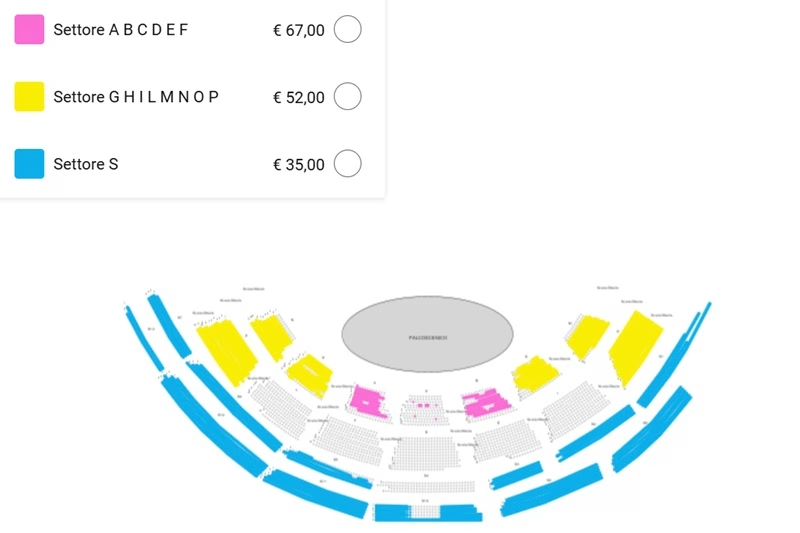
A simple seating plan: central pink sectors A–F, mid-yellow G–P and outer blue S, each with its own ticket price.
Language and translations
Performances are in Italian, using modern translations of the original Greek texts.
Check the language and any translation support for your chosen production when booking.
Even without fluent Italian, many visitors find that a short synopsis read in advance, plus the strength of the staging, chorus and music, is enough to follow the main thread.
Weather and what to wear
May evenings are usually mild; a light jumper or scarf is still useful once the sun has gone.
June is warmer; you may want a sunhat and sunglasses for the wait before the performance, and a light layer for later on.
Weather can affect an open-air performance. Check INDA’s current cancellation and postponement policy when booking.
Allow time for the walk to your seat and arrange your return to the hotel in advance.
Include the theatre in your Sicily holiday
A night at the Greek Theatre makes a natural centrepiece for:
a long weekend in Siracusa, with one evening reserved for the festival and the others for slow dinners by the sea;
a wider tour of South-East Sicily, combining Siracusa with Noto, Modica and Ragusa;
or a longer holiday combining Siracusa with Mount Etna, and the Aeolian Islands.
Tell us which production you would like to see and when you can travel. We can arrange your Siracusa hotel and local transfers around the performance, with time for Ortigia, the archaeological park and relaxed meals by the sea.
You are in good hands




Tailor-made Italy holidays, thoughtfully planned by ExpertoItaly.
Characterful places to stay, thoughtful routes and well-planned travel between them — across one region or several.
We arrange your accommodation, transport and experiences in Italy. Flights are booked separately.
About ExpertoItalyPlan with ExpertoItaly
Tell us where you would like to go, when you can travel and what matters to you.
Start planning your Italy holidayMonday–Thursday: 9am–6pm
Friday: 9am–5.30pm · UK time
At weekends, please send an enquiry.
Your holiday protection

Travel Trust Association
Member Q8055
Read how your holiday payments are protected through our TTA membership.
How your holiday is protectedItaly ideas and travel advice by email
Subscribe for destination ideas, places to stay and practical advice from ExpertoItaly.
We will never sell your details. Read our privacy policy.
Follow ExpertoItaly
 Facebook
 WhatsApp channel
Follow our travel updates. For help planning your own holiday, contact ExpertoItaly.
ExpertoItaly Ltd · Company registration no. 12035194 · TTA membership Q8055
Package holidays are sold by ExpertoItaly Ltd. Registered office: 33 Miles Close, London, SE28 0NJ.