Naples is a city of layers. You’ve met the Greek shoreline of Partenope and the Roman-medieval grid. Now step into Bourbon Naples—the age when the city behaved like a European capital.
Between the mid-eighteenth and mid-nineteenth century, the Bourbons did not merely decorate Naples; they reorganised it. They laid out processional lines, raised an opera house of European rank, staged power across a new piazza and anchored life with palaces, galleries and broad avenues.
However, the era also brought sharp contrasts. Courtly splendour sat beside working-class hardship. Enlightened reforms met censorship. Festivals paused for revolutions. This Bourbon Naples guide shows you how to read that story through the places where it still lives.
Begin on Via Toledo, a long, straight boulevard first cut by a Spanish viceroy to tame medieval lanes. By Bourbon times it had settled into its role: a public stage. Carriages once announced status here. Today, shopfronts and palazzi still frame a steady parade of people and glances.
A block uphill, the Quartieri Spagnoli (Spanish Quarters) change the rhythm. Built to house troops, the steep grid became Naples’ domestic engine. Carpenters worked at street level. Hawkers called to balconies. Washing lines stitched façades together.
The quarter also forged the lazzari—dockers and day-labourers whose mood could sway politics. In 1799 many fought to restore the king after a brief republic. In 1848 the same lanes hosted liberal demands. The paradox holds: a district created to control Naples eventually expressed it most vividly.
Look for votive shrines glowing at dusk. They mark communal resilience through plagues, poverty and politics.
Read it today: Walk Toledo end-to-end; then take a coffee in a tiny bar inside the Quartieri. Feel the snap from intimate to monumental. That contrast is the point.

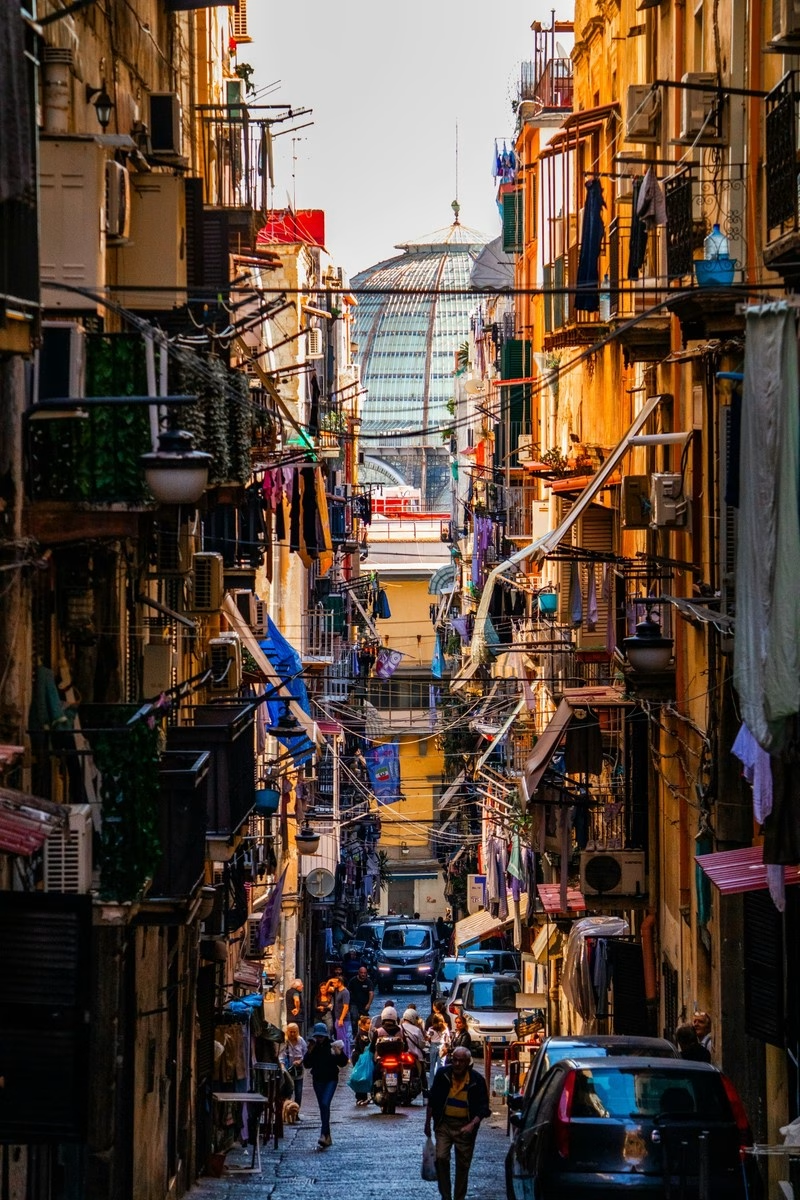
A vicolo in the Quartieri Spagnoli aligned on the Galleria Umberto I dome: the neighbourhood’s lived-in grid meets the civic stage of Bourbon and post-Bourbon Naples in a single sightline.
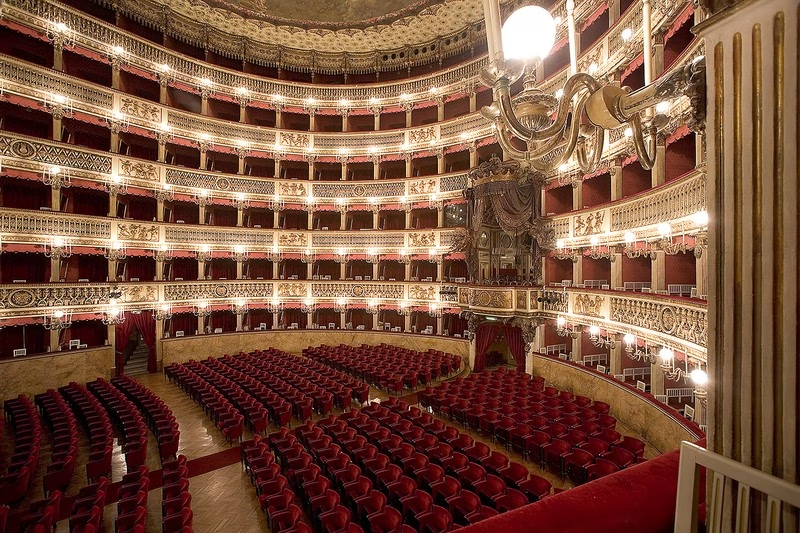
Opened in 1737, Teatro di San Carlo is Europe’s oldest continuously active opera house. Its horseshoe auditorium, crowned by a royal box, quietly teaches hierarchy. Here the monarchy curated civilisation in public.
San Carlo made Naples the engine-room of eighteenth-century opera. Composers premiered here; star singers were minted here. For audiences it was spectacle. For the crown it was soft power. When fire struck in the early nineteenth century, the theatre rose again within a year. Rebuilding culture rebuilt legitimacy.
Later restorations changed colours, not meaning. The room still focuses your gaze and tightens your breath.
Read it today: Book a tour—and, if possible, a performance. The acoustic makes the case for Bourbon Naples better than any panel.

Inside Teatro di San Carlo (1737): tiers of gilded boxes curve around the horseshoe hall, centred on the royal box—proof that in Bourbon Naples, culture was a language of power.
Facing the bay, the Royal Palace is a machine for monarchy. Spanish viceroys began it; the Bourbons refined it. A sequence of staircases, anterooms and salons choreographs rank and access.
Under Charles, the palace hosted reforms: modern laws, academies, collections. Naples felt like an Enlightenment laboratory. The Revolution changed the weather. In 1799 a republic appeared; within months, royal flags returned. Later, Ferdinand I ruled the Two Sicilies with more ritual and more policing.
By mid-century, splendour sat beside nerves. Ferdinand II sponsored factories and railways—yet also commissioned a Bourbon Tunnel beneath the city as a private route to barracks and the sea. The façade later gained statues of past rulers, stitching the dynasty into a longer story. After unification, a wing became the National Library; the apartments opened as a museum.
Read it today: Climb the ceremonial staircase. Pause in the Throne Room. From the gardens, look back and read the façade like a timeline.

Inside the Royal Palace (Palazzo Reale): a state apartment lined with tapestries, frescoed vaults and a glittering chandelier. Rooms like these choreographed rank and ritual in Bourbon Naples.

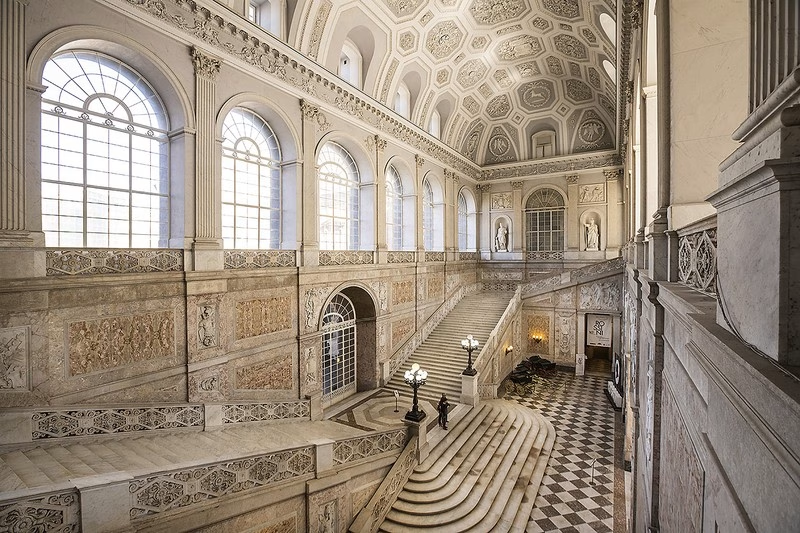
The Grand Staircase of the Royal Palace (Palazzo Reale). Flooded with light and lined with statues, it turns arrival into ceremony—an architectural prelude to the Bourbon state apartments above.
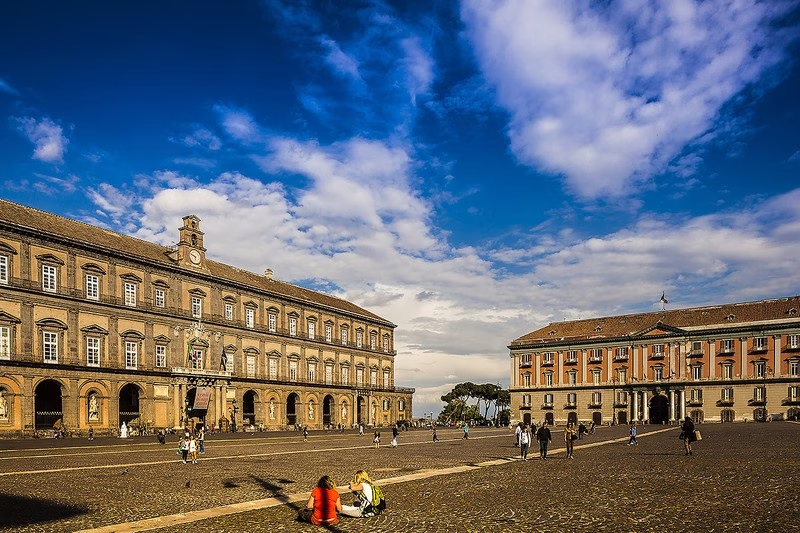
Piazza del Plebiscito was conceived under Napoleon’s king and completed by a Bourbon. The domed Basilica of San Francesco di Paola faces the Royal Palace across a broad stone floor. Altar and throne hold a quiet conversation.
Two bronze equestrian statues—Charles of Bourbon and Ferdinand I—anchor the view. Yet the square’s name recalls the plebiscite of 1860 that confirmed union with Italy. In one frame you read French ambition, Bourbon piety and Savoy nation-building.
The piazza has hosted parades, proclamations and protests. It briefly suffered as a car park. Thankfully, it is now pedestrian—Naples’ formal living room.
Read it today: Scan the colonnades from the basilica steps; then cross to the palace and look back. Great civic rooms outlive their scripts.

Piazza del Plebiscito seen between the Royal Palace and the salmon-coloured Palazzo Salerno (the Prefecture): a stage where Bourbon ceremony, Napoleonic plans and Italian unification all left their mark.

From a window inside the Royal Palace, the Basilica of San Francesco di Paola and its colonnades fill the frame—altar and throne facing across Piazza del Plebiscito, the Bourbon city’s great civic stage.
After cholera came the risanamento—a health-driven plan to open light and air. Galleria Umberto I (1890) turned policy into pleasure. A Latin-cross arcade of iron and glass meets under a great dome. One arm joins Via Toledo; another touches San Carlo. It is a hinge between royal and bourgeois Naples.
Look up at allegories of continents and industry. Look down at the mosaic compass and zodiac. Most of all, notice the habit: meeting, strolling, browsing. Authority now feels like ease.
Read it today: Enter from Toledo, pause under the dome, then step straight into San Carlo’s orbit.

The Galleria Umberto I entrance by Via Toledo in the blue hour. This corner stitches the Bourbon centre together—opera house, gallery and boulevard—turning policy into everyday promenade.

Looking up inside Galleria Umberto I: the great glass dome meets the barrel vaults of the cross-shaped arcade, where post-Bourbon Naples turned health and commerce into everyday pleasure.

Inside Galleria Umberto I: under the great iron-and-glass canopy, cafés and shopfronts turn the late-19th-century risanamento into a daily promenade—linking Via Toledo with San Carlo and the Bourbon centre.
Maschio Angioino predates the Bourbons yet completes their stage. Five round towers say “fortress”. The white-marble triumphal arch between them says “arrival”. Kings came and went; the castle kept armouries, offices and a garrison.
It also watched the port where Naples made and lost fortunes—from grain fleets to steamers. Legends cling to its dungeons. However, the real lesson is continuity: a medieval body taking modern roles without losing its outline.
Read it today: Enter beneath the arch; look up at the star vault in the Hall of the Barons; then step out to Piazza Municipio and trace the whole Bourbon composition.

Maschio Angioino—the medieval fortress that anchors the Bourbon centre by the harbour. Its round towers frame the white-marble triumphal arch, linking Angevin roots to later dynasties.

The white-marble triumphal arch of Maschio Angioino (Castel Nuovo), squeezed between two medieval towers. Carved to celebrate a royal entry, it bridges the fortress’s Angevin past with the dynasties that followed.

Detail from the triumphal arch of Maschio Angioino (Castel Nuovo): soldiers carved in pale marble catch the afternoon light—a close look at the Renaissance façade that bridges the fortress’s medieval body to later dynasties.
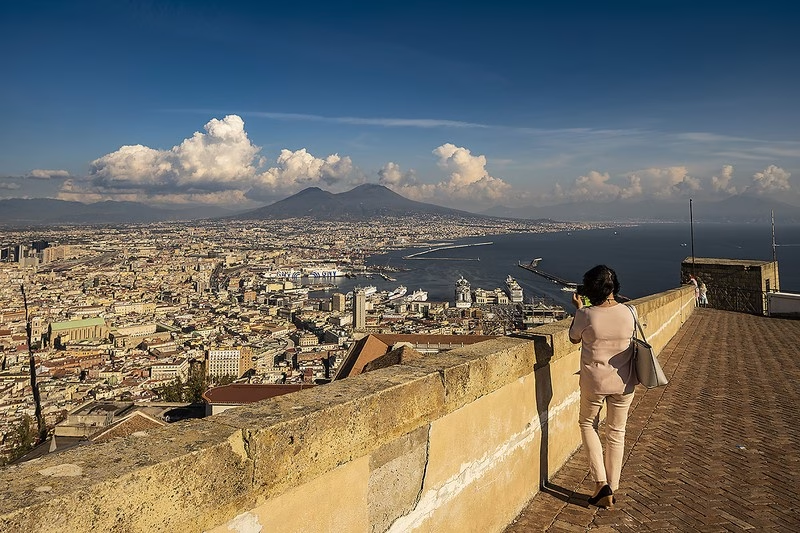
End with altitude. On the Vomero hill, Castel Sant’Elmo and the terrace of the Certosa di San Martino give the cleanest diagram of the Bourbon centre. See Via Toledo as a ruler-straight line, the piazza’s embrace between palace and basilica, the Galleria’s glass crown and Maschio Angioino at the harbour hinge.
Sant’Elmo is medieval in body and Bourbon in function—garrison, lookout, pressure gauge.
Getting there: Take the Funicolare Centrale from Augusteo (by Galleria Umberto I / Via Toledo) to Piazza Fuga; walk 5–10 minutes to Sant’Elmo and the Certosa terrace. Best light: late afternoon.

On the ramparts of Castel Sant’Elmo: the clock-tower terrace surveys the bay and Vesuvius. From here you can read the Bourbon plan below—Via Toledo’s line, Piazza del Plebiscito and the harbour hinge of Maschio Angioino.

From Castel Sant’Elmo, the Bourbon city spreads below—port, palaces and Via Toledo—while Vesuvius anchors the horizon. This is the clearest vantage to “read” the plan of Naples in one glance.
Commissioned by Ferdinand II in the 1850s, the Bourbon Tunnel links the palace area to barracks and the seafront. It became a wartime shelter and is now a guided walk through cisterns and galleries. Few cities let you stroll a monarchy’s what-if.

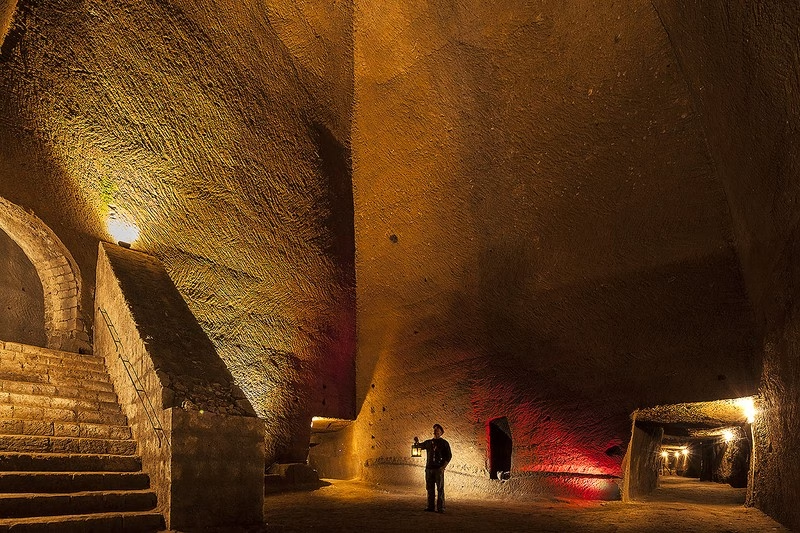
Inside the Galleria Borbonica: vast tufa chambers from a mid-19th-century tunnel linking the Royal Palace to barracks and the seafront—later an air-raid shelter, now a gripping guided route beneath Bourbon Naples.
Capodimonte began as a royal retreat and a home for the Farnese collection. The surrounding Real Bosco adds a green counterweight to the centre. Nearby porcelain works turned court taste into industry.
On Via Toledo, Palazzo Zevallos shows how finance and culture met. Today it houses Caravaggio’s Martyrdom of Saint Ursula—a quiet masterpiece on the boulevard of display.
Piazza Municipio (Maschio Angioino) → Via Toledo (coffee detour into the Spanish Quarters) → Galleria Umberto I → Teatro di San Carlo → Piazza del Plebiscito → Royal Palace.
If time allows, add Bourbon Tunnel. On another day, ride up to San Martino/Sant’Elmo, or out to Capodimonte.
Together, these places explain how a royal city works—and how it changes.
Via Toledo is monarchy’s map: straight, legible, processional.
Spanish Quarters are the counter-map: improvised, intimate, communal.
San Carlo turns art into policy.
The Royal Palace turns rooms into ritual.
Piazza del Plebiscito absorbs new regimes without losing poise.
Galleria Umberto I makes health and commerce feel like pleasure.
Maschio Angioino repurposes older power for new centuries.
You’ll leave with more than dates. You’ll carry concepts—and stories that travel further than your flight.
Plan it with ExpertoItaly: sensible pacing, well-timed entries and a route that clicks in the right order.
Clients often mention what matters most — care, precision, and the sense of travelling with someone who knows the way.
EXCELLENT Based on 74 reviews Posted on Anne Fenton22 September 2025Trustindex verifies that the original source of the review is Google. Antonio was a delight to deal with. He was knowledgable, friendly and very patient when we changed our plans several times! His choices of hotels were exceptionally good and he was very responsive when we had a little hiccup with the car rental. Highly recommend his services.Posted on Teresa Oliveira25 August 2025Trustindex verifies that the original source of the review is Google. We used ExpertoItaly to help us with our two-week holiday in Sicily. We had a couple of interactions with Antonio, and were very fast to close on our itinerary and hotels. Everyting was very well organized and suitable to our requirements. Antonio chose very good accommodations: small beautiful, full of character and well located. He also booked our bus trips as we did not want to rent a car. That worked really well. It was a great help and gave us great confidence for our trip. We strongly recommend ExpertoItaly if you want customised holidays in Italy. We will use it again for future traveling in Italy!Posted on IzzieD21 August 2025Trustindex verifies that the original source of the review is Google. Antonio is an expert on Italy so if you are planning a trip then you should definitely use ExpertoItaly. He helped us plan the perfect family trip and we cannot fault any of his recommendations. From car hire, to the perfect hotels and apartments, he is highly knowledgeable and it doesn't stop with planning. He was on hand to be available if we needed his help while on the trip. His customer service is first class. Thank you so so much and we look forward to planning our next trip with you.Posted on David Wise12 August 2025Trustindex verifies that the original source of the review is Google. Antonio was really helpful in planning our trip to Italy. We wanted to visit 3 locations, he provided recommendations on accomodations which were great - really good locations for each booking. He also coordinated taxis and trains and provided a load of suggestions for each location for places to eat and sites to visit. He was readily available to answer any questions we had by email or WhatsApp. His assistance really helped us in planning this trip and saved us a lot of stress in trying to coordinate this ourselves. All in all we had a great holidayPosted on Simon Tanner8 July 2025Trustindex verifies that the original source of the review is Google. Antonio organised a wonderful two-centre trip for us. He listened to our requirements and designed an itinerary that fulfilled our needs perfectly. All the arrangements (hotels, transfers, bike hire, train tickets etc.) went smoothly and Antonio was available before and during the holiday to answer any queries. He is helpful and charming. The pricing was very competitive and the holiday good value for money. I would recommend ExpertoItaly to anyone looking for knowledgeable, excellent customer service and look forward to using Antonio’s services again in the future.Posted on Paul Bowtell2 July 2025Trustindex verifies that the original source of the review is Google. Would recommend ExpertoItaly to anyone. Antonio's expertise and great customer service combined to make our Sicily holiday a 100% hit. We had a rough idea of where and what we wanted to do, but Antonio fine tuned our ideas into a fabulous itinerary (Syracusa and Savoca based). He helped smooth any problems, gently reminded us to fill in the needed forms/provide info and made sure all was going well. Can't praise him enough, especially as he is a very small operation.Posted on Anna Connor24 June 2025Trustindex verifies that the original source of the review is Google. Would not hesitate to recommend Antonio - who planned our perfect honeymoon. I got in touch asking for advice on Italy 3-week itineraries, he sent a few options and I picked one and we worked together to adapt and perfect the locations we wanted to visit. Antonio then booked accommodation in each place, even being so specific to choose exact rooms he thought were the best in each hotel. He reserved cars, ferries and private transfers throughout the trip and took all the stress away and everything went seamlessly. His knowledge of every place and the activities to do / restaurants to visit was so helpful too. We ended up experiencing such a varied and beautiful Italy and visited places we would not have known about if not for Antonio. He is always available on whatsapp or for a phone call and was so helpful in changing our plans slightly when our flight got cancelled, and always available whilst we were away if we had any questions. If you are thinking of an Italian holiday do it! Who better to help plan than an Italian that is passionate about all his country has to offer?Posted on Adam R20 June 2025Trustindex verifies that the original source of the review is Google. From the moment we were introduced to Antonio, we knew we were about to embark on a fabulous holiday. We simply told him that we wanted a week away in Sicily. He did the rest.. from arranging top quality transfers to planning the trip incorporating two fabulous hotels. Focused on the minute detail, to setting up a WhatsApp group so that we could keep in touch whilst we were away, his service was impeccable. Without doubt, when we next venture to Italy, he will be our first call and I suggest you do the same!Posted on Mike Girling (No nickname)31 May 2025Trustindex verifies that the original source of the review is Google. Just back from 10 wonderful days in Sicily a fantastic trip made possible by the sheer expertise of Antonio. We had considered going to Sicily on 3 separate occasions but it was only when we spent time talking to Antonio that the magic of a trip to Sicily became a reality. His choice of accommodation has enabled us to experience genuine Sicilian hospitality at its best in fantastic locations and with expert guides to ensure we fully appreciated our surroundings. We didn't want to drive so Antonio organized drivers to transport us between locations. We have had a memorable experience and will use Antonio again to ensure we have further great times in Italy. Thank you Antonio Mike & DianePosted on Elaine Yeoh8 November 2024Trustindex verifies that the original source of the review is Google. We engaged Antonio Cresce to plan and manage our 2.5 week holiday in Italy - covering regions around Turin, Lake Maggiore and Verona. He was amazing from the planning stages, helping us to pick towns as bases, according to our needs and interests . We had video calls with him where he listened to what we wanted and we planned the details together. When we were in Italy, he kept in close contact and was readily available for any questions or issues we came across . The hotels he chose were incredible , and the excursions from the towns we stayed in were interesting and great experiences. His contacts, his experience and his professionalism made our holiday in Italy seamless and a truly wonderful experience! We would highly recommend Antonio from Expert to Italy !
👍 Follow us on Facebook – Stay inspired with daily updates, travel ideas, and a community of fellow Italy lovers.
📲 Join our WhatsApp channel 🟢 – Get instant updates, behind-the-scenes insights, and connect directly with our team.
We’ll always treat your details with the utmost care and will never sell them to other companies. See our privacy policy
Package holidays are sold by ExpertoItaly Ltd (Reg. 12035194)
Call us on +44 (0) 77 3838 5790
Registered office: 33 Miles Close, London, SE28 0NJ
Monday – Thursday 9am to 6pm
Friday 9am to 5:30pm
Saturday – please send us an enquiry form
Sunday – please send us an enquiry form