Uncover the Charm of Taormina: A Dolce Vita Escape

Cultural Sea Breaks in Sicily

Taormina combines one of Sicily’s most important ancient settings with a historic town high above the Ionian coast. Yet the upper town, hillside hotels, Mazzarò and Isola Bella do not create the same stay. Where you sleep determines whether evenings, beaches and daily movement feel easy or depend on cable cars, shuttles and taxis.

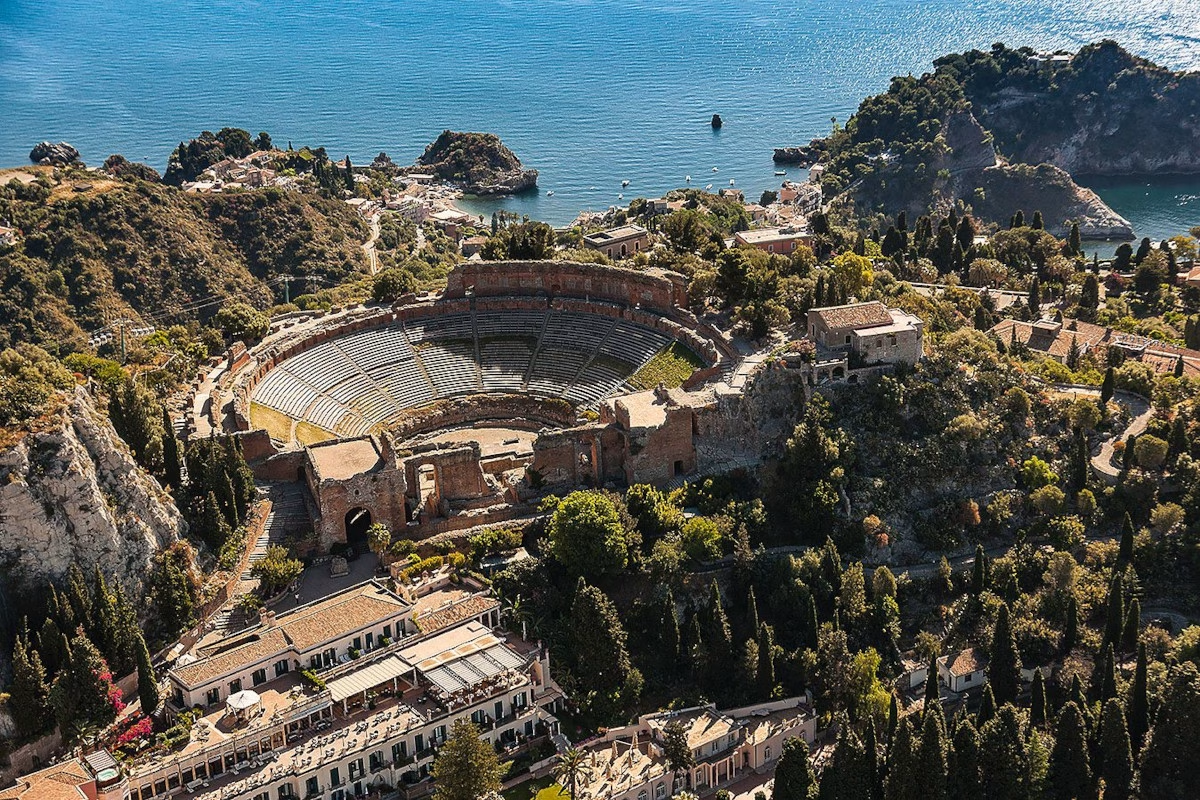
Aerial view of the Ancient Theatre, hillside and Ionian coast at Taormina
The Ancient Theatre, upper town and Ionian coast introduce Taormina as a cultural destination shaped by its steep geography.

Taormina works best when its fame is set aside for a moment and the geography is considered properly.

The historic centre sits high on the slopes of Monte Tauro. Corso Umberto, the Ancient Theatre, Piazza IX Aprile and many restaurants can all be reached on foot when the hotel is well placed. The sea is visible almost everywhere, but it lies far below the town. Mazzarò and Isola Bella belong to Taormina geographically, while functioning as a separate coastal setting in everyday holiday terms.

This is why two hotels described as being in Taormina can produce very different holidays. One may allow an easy evening walk to dinner; another may provide a larger terrace and stronger view but require a shuttle or steep return. A coastal hotel may make swimming easier while turning every evening in the upper town into a small transport plan.

Taormina belongs within our wider guide to Cultural Sea Breaks in Sicily , but it needs its own practical judgement because culture and sea occupy different levels of the landscape.

In Taormina, a sea view is not the same as beach access — and a short distance on a map may still involve a steep walk, steps or a shuttle.

Taormina at a glance

Why Taormina matters

Taormina is not culturally important simply because it is well known. Four qualities distinguish it from a conventional coastal resort.

01

Theatre and landscape

An ancient monument whose setting is part of its meaning

The theatre developed from a Greek structure and was enlarged and adapted under Roman rule. Its architecture, the Bay of Naxos and the presence of Etna are experienced together rather than as separate sights.

02

The historic town

Several periods of Sicily within a compact centre

Greek and Roman remains, medieval streets, palaces, churches and later resort culture sit along and around Corso Umberto. The town is compact enough to explore slowly rather than by checklist.

03

Vertical geography

A historic town above a separate coastal rhythm

The upper town and the bays below are close in a straight line but separated by height. Cable car, road, steps and hotel transport make the connection possible without making the two settings interchangeable.

04

Resort history

A long tradition of visitors, hotels and evening life

Taormina became an established European resort during the nineteenth century. That history still shapes its gardens, hotels, theatres and polished evening atmosphere, but it also explains the intensity of demand in the busiest periods.

Aerial view of Taormina’s historic centre on the slopes of Monte Tauro
From above, the compact historic centre and steep surrounding slopes explain why hotel position matters more than a simple map distance.

Planning eastern Sicily

Taormina works best when its polished resort atmosphere is treated as the purpose of the stay rather than simply as a base for eastern Sicily. Our Taormina and Mount Etna destination guide explains how the upper town, hillside and coast create different versions of that holiday.

The historic town

The Ancient Theatre and Taormina’s cultural depth

The Ancient Theatre is Taormina’s defining monument, but the historic centre becomes more rewarding when Corso Umberto is treated as its spine rather than the entire experience.

Taormina contains Greek, Roman, medieval and later resort history within a compact town that is best explored slowly.

The earliest theatre occupied this site by the third or second century BC. Under Roman rule it was enlarged and altered for different forms of public entertainment. The surviving building therefore records more than one period: Greek origins, Roman engineering and the later reuse of an ancient monument as a modern performance setting.

The opening behind the stage frames Etna and the Ionian coast, but the view should not reduce the visit to a photograph. Walk through the seating, examine the surviving stage structures and allow time to understand how the building changed. Summer performances can affect access, so the theatre is best treated as a planned cultural visit.

Mediterranean gardens and historic follies in Taormina Villa Comunale
Villa Comunale provides a quieter pause between the theatre, viewpoints and busier streets.
Historic pedestrian street in the centre of Taormina
The lanes branching from Corso Umberto reward a slower exploration of the upper town.

Beyond the theatre

Corso Umberto and the layers of the town

Corso Umberto

The pedestrian spine—not the whole historic centre

Corso Umberto runs between Porta Messina and Porta Catania, joining the principal squares, churches and palaces. It provides the clearest introduction to Taormina, but it is also the town’s busiest and most commercial route.

The historic centre becomes more interesting along the lanes, stairways and small courtyards immediately beyond it. These quieter routes reveal workshops, galleries, domestic buildings and unexpected views that are easily missed when Corso Umberto is treated simply as a route between two gates.

Palazzo Corvaja and the Odeon

Architecture built in stages

Palazzo Corvaja contains Arab, Norman and Gothic elements developed across different periods. The nearby Roman Odeon survives partly enclosed by later buildings. Together they show how Taormina repeatedly built over and around its earlier fabric rather than preserving each historical period in isolation.

Piazza IX Aprile

A viewpoint within the social life of the town

Piazza IX Aprile is both a celebrated viewpoint and part of the town’s daily movement. Early morning is relatively calm; later it becomes a stage for the passeggiata, musicians, café tables and visitors crossing between the two ends of Corso Umberto.

This changing atmosphere is one of the advantages of staying in the upper town. It can be experienced before the main daytime arrivals and again in the evening without organising a cable car, shuttle or taxi back to the coast.

Art beyond antiquity

Casa Cuseni and Taormina’s artistic life

A planned cultural visit

Casa Cuseni

Casa Cuseni adds an important twentieth-century chapter to Taormina. Built for the British painter Robert Hawthorn Kitson, the house, collections and garden reflect the international community of artists, writers and travellers that gathered in the town.

The house is now the Museum of Fine Arts and the Grand Tour of the City of Taormina. Visits are guided and require advance reservation, so Casa Cuseni should be planned rather than left as an incidental stop. Its elevated position also involves an uphill approach from Corso Umberto.

Galleries along the Corso

Historical Sicily and contemporary art

Taormina’s artistic identity also appears in smaller spaces along Corso Umberto. L’Agorà di Lorino Consoli specialises in antique maps, prints, paintings, books and objects connected with Sicily and the visual history of travel.

Further along the Corso, Taimeless Art Gallery provides a contemporary counterpoint through painting, sculpture, photography and jewellery. These are commercial galleries rather than museums, but they reward travellers who are prepared to browse slowly rather than move directly between the principal monuments.

Historic pedestrian street in Taormina during the evening passeggiata
Taormina’s evening atmosphere is one reason to stay rather than visit for the day. The benefit is greatest when the hotel is genuinely walkable from the historic centre.

From lunch to late evening

The historic centre after the monuments close

Taormina’s centre is polished, but it need not mean formal dining at every meal. Da Cristina is a useful option for arancini, focaccia and other Sicilian rosticceria when a quick, informal lunch suits the day better than a long restaurant stop.

In the evening, different addresses serve different moods. Re di Bastoni is informal and associated with live music; Casamatta combines natural wines with a quieter setting away from the main flow; Morgana offers a more designed, late-evening cocktail atmosphere. Programmes, opening days and the character of individual evenings change, so current arrangements should be checked locally.

These places are not included as a checklist. They demonstrate why the upper town continues to function after sightseeing hours. A centrally positioned hotel allows travellers to choose between an early dinner, a slow passeggiata, live music or a later drink without turning the evening into a transport exercise.

The essential planning decision

Upper town, hillside or coast?

“Taormina” can describe accommodation in several distinct settings. The address alone does not tell you how the stay will work.

Upper town

Best for cultural days and evenings on foot

A hotel within a comfortable walk of Corso Umberto gives the simplest short stay. The theatre, gardens, squares, restaurants and evening passeggiata belong to the same pedestrian routine. Beach time still requires a descent by cable car, bus, taxi or a substantial walk, but the town itself does not need daily transport.

“Central” must be tested against the actual route. A property may be close in distance but reached by a steep road or a long flight of steps. Travellers with restricted mobility should not rely on map measurements alone.

Hillside hotels

Stronger views, with movement built into the day

Hotels above or beyond the centre often gain space, terraces, pools and wider sea views. Those advantages exist because the property is removed from the easiest pedestrian routes. Some provide a shuttle; others work better with taxis or confident uphill walking.

Check the shuttle’s final return as carefully as its daytime service. If the hotel restaurant is not part of the plan, evening transport can determine whether the location feels peaceful or restrictive.

Mazzarò

Part of Taormina, but a coastal stay in practice

Mazzarò sits beside the sea around the lower cable-car station. Its hotels and lidos give the day a more coastal rhythm: swimming can be easier, hotel facilities matter more and the upper town becomes a place reached deliberately rather than simply stepped into.

This can be exactly right for travellers who put sea time first. It is less suitable for anyone imagining that Corso Umberto will be outside the door each evening.

Isola Bella

A celebrated bay, not a step-free resort beach

Isola Bella lies in the neighbouring bay below the town. The shore is pebbled and access commonly involves walking and steps. The islet is joined to the mainland by a narrow isthmus whose appearance changes with water conditions.

Staying nearby reduces the main descent from the upper town, but it does not make every hotel door-to-beach. Exact access and hotel beach arrangements still need to be understood before booking.

Aerial view of Mazzarò Bay and Isola Bella below Taormina
Mazzarò and Isola Bella form the coastal side of Taormina. The upper town remains above and out of frame: close geographically, but a different base in practical terms.
Taormina’s steep hillside rising above the Ionian coast
The coastline and upper slopes occupy different levels, so apparently nearby accommodation can require very different daily movement.
Elevated walkway and historic buildings in Taormina at dusk
Elevated viewpoints and historic routes are part of Taormina’s appeal, but slopes and steps must be considered when choosing a hotel.

Connecting the levels

What the cable car solves — and what it does not

The cable car joins the upper station near the eastern side of the historic centre with Mazzarò below. It is an important connection, particularly for travellers staying in town who want several hours beside the sea.

It does not serve every hotel and it does not remove all walking. Reaching Isola Bella from the lower level still involves the local road and steps. Hillside properties may sit away from either station, while coastal hotels beyond Mazzarò may use their own shuttle or require a bus or taxi.

Operating hours, queues and maintenance periods also matter. For an evergreen plan, treat the cable car as the principal public link but retain an alternative for late dinners, temporary closure or a hotel that is not naturally aligned with the route.

Choose the hotel for the part of Taormina you want to live in every day, not for the view you hope to visit occasionally.

Beach and coast

Which Taormina beach experience suits your stay?

Taormina’s coast is visually exceptional, but it is not one continuous beach. Isola Bella, Mazzarò and the longer shores further north create different days—and staying beside the sea creates a different holiday from staying in the upper town.

Isola Bella and its pebbled shore below Taormina

Isola Bella

Taormina’s defining coastal image

Isola Bella is the coast at its most dramatic: a small islet, clear water and a sheltered bay beneath the cliffs. It is somewhere to experience for its setting, but it is not necessarily Taormina’s easiest or most comfortable beach day.

The shore is predominantly pebbled and rocky, and the entrance to the water can be uneven. Water shoes are useful. Public sections and equipped lidos are available, but space is limited and the bay can feel intensely crowded during peak summer.

From the upper town, the cable car descends to Mazzarò rather than directly to Isola Bella. Reaching the bay requires a further walk and a series of steps. This matters for families carrying beach equipment and for anyone with reduced mobility.

Mazzarò

The most practical connection from the upper town

Mazzarò is a compact, sheltered bay served by the cable car from Taormina. Its shore is pebbled rather than sandy, with hotels, restaurants and organised lidos occupying much of the limited waterfront. Public access remains available, although the free sections can be constrained at busy times.

For visitors staying in the upper town, Mazzarò is usually the simplest place for a planned beach day. The cable car makes the change in height manageable, but queues, seasonal operating hours and the walk between the hotel and station still form part of the journey.

Staying in Mazzarò changes the emphasis. Morning swims and late afternoons beside the water become easier, while dinners and evening walks in Taormina depend on the cable car, a hotel shuttle or a taxi. In practice, Mazzarò is connected to Taormina but does not provide the same evening experience.

Lido La Pigna on the shore at Mazzarò below Taormina

An ExpertoItaly recommendation

Lido La Pigna in Mazzarò

For a comfortable beach day from the upper town, we recommend Lido La Pigna . Its position in Mazzarò makes it straightforward to reach using the cable car, while organised loungers, changing facilities, showers and beach service remove much of the practical uncertainty from the day.

The lido also has a sea-view terrace for lunch and can help arrange activities such as boat trips, kayaking and paddleboarding. It is a good example of why Mazzarò can work well for visitors who want a planned, serviced beach day rather than competing for limited public space at Isola Bella.

Advance booking is advisable during the busiest summer periods. Opening dates, services and reservations should be confirmed directly with the lido before travel.

The steep Ionian coastline below Taormina
The sea may appear close from Taormina, but the cliffs, roads and difference in height determine how easily it becomes part of each day.

Beyond the famous bays

Where to find a more conventional beach day

Spisone and Mazzeo

More space along the northern coast

Spisone and Mazzeo offer longer, more open stretches of shore than Isola Bella or Mazzarò. There are public sections and organised lidos, with more scope for spending a full day beside the water. The shore remains largely pebbled or shingly rather than soft sand.

These beaches are reached by road or local transport, not by the Mazzarò cable car. They can work well for repeated beach days, but they are less convenient for spontaneous evenings on Corso Umberto.

Giardini Naxos

A separate seaside base

Giardini Naxos has a broader, more level seafront, a greater choice of lidos and restaurants, and a stronger everyday seaside-town rhythm. It can suit travellers who value straightforward coastal access over staying within Taormina’s historic setting.

It should not be described as another Taormina neighbourhood. Staying there means arranging transport when visiting the Ancient Theatre, Corso Umberto or Taormina’s restaurants in the evening.

Public beach, lido or hotel beach?

Public access exists along the coast, but the most convenient sections are often limited and become busy in summer. A lido provides loungers, umbrellas, changing facilities and usually food service; advance booking can be worthwhile in peak periods. A hotel advertising a private beach may provide access to an affiliated lido or reserved section rather than a beach directly outside the property.

Isola Bella provides Taormina’s defining coastal image. Mazzarò offers the closest practical beach connection. Spisone, Mazzeo and Giardini Naxos provide more beach-oriented alternatives—but increasingly separate the stay from evenings in Taormina itself.

Choosing the period

When to visit Taormina

Taormina has a long season, but the relationship between culture, beach time and visitor pressure changes considerably.

Spring

Best for the town, theatre and active days

Spring usually provides comfortable conditions for the historic centre, theatre and excursions around eastern Sicily. Gardens are at their strongest and the heat is less restrictive. Later spring can include useful beach weather, although the sea may still feel cool to travellers expecting a swimming-led stay.

Early summer

Longer evenings before peak pressure

June offers a stronger balance for travellers who want the town and the sea. Visitor numbers and temperatures rise, but the full pressure of July and August has not necessarily arrived. Events at the theatre can add interest while also affecting access.

July and August

Reliable summer conditions, intense demand

Expect heat, busy streets, crowded bays, congested roads and strong demand for restaurants, lidos and the cable car. Taormina can still work well when the hotel supplies a pool, space and a reason to spend time there. It is less convincing as a base from which every day is filled with driving and excursions.

September and early October

The strongest balance of warm sea and cultural time

September often retains good swimming conditions while reducing the most intense summer heat. It remains popular and should not be described as quiet. Early October is attractive for culture and walking, while beach plans become more dependent on the weather.

Busy pedestrian street in Taormina during a popular travel period
Peak periods bring substantial pressure to Taormina’s compact pedestrian centre; central does not always mean calm.
Historic square in Taormina illuminated at dusk
Staying overnight gives access to Taormina’s evening atmosphere after the main sightseeing hours.

Length of stay

How many nights should you spend in Taormina?

The right number depends on whether Taormina is a cultural chapter, a base for carefully chosen excursions or a slower coastal stay.

3 nights

A concise Taormina stay

Enough for the theatre, historic centre, gardens, one visit to the coast and two evenings in town. This works particularly well at the beginning or end of a wider Sicily journey.

4–5 nights

Culture, coast and one substantial excursion

Better when adding a guided Etna or Alcantara day, meaningful beach time, a boat outing or a day kept partly free for the hotel. This is often the most balanced standalone Taormina stay.

7 nights

A slower holiday with a clear purpose

A week is justified when the accommodation itself contributes a pool, terrace, gardens or good coastal access and the intention is to reduce movement. Seven nights are not automatically better when most days will be spent leaving Taormina.

When a longer stay is the wrong choice

During peak summer, a week in an intensely central hotel can feel busy if there is little outdoor space. Travellers who want vineyards, countryside and quieter pool days may gain more from dividing the stay between Taormina and an Etna-area stay. Conversely, travellers choosing Taormina for its views, evenings and hotel life can use Etna and the Alcantara valley as excursions without creating another hotel move.

Putting Taormina into the route

The combinations that give Taormina a clear role

Taormina is strongest when it contributes something distinct to the journey rather than becoming a convenient name attached to every day in eastern Sicily.

Taormina and Siracusa eastern Sicily holiday route

A concise eastern Sicily journey

Taormina and Siracusa

This is one of the clearest short combinations in Sicily. Taormina brings the Ancient Theatre, elevated sea views, access to Etna and a polished resort atmosphere. Siracusa brings Ortigia, archaeological depth, Baroque streets and waterfront evenings at sea level.

The two places complement one another without requiring a car when transfers are arranged properly. A seven-night journey can work well, with the division adjusted according to flights, Etna plans and how much time you want to give Ortigia.

See the Taormina and Siracusa twin-centre holiday
Sicily journey combining Palermo, Salina and Taormina

A longer car-free Sicily route

Palermo, Salina and Taormina

Palermo supplies the energetic cultural opening. Salina slows the journey with a full island week. Taormina then works as a concise eastern finish, returning the route to the main island and placing the final stay within reach of Catania Airport.

The value lies in the 4 + 7 + 3 rhythm rather than in moving quickly across Sicily. Ferry times, luggage and the final airport transfer determine the order. Taormina closes the holiday with theatre, views and hotel comfort without asking it to provide the entire coastal stage.

See the Palermo, Salina and Taormina journey

Eastern Sicily decisions

Excursions that justify a longer Taormina stay

Mount Etna

A serious excursion, tailored around the traveller

A private Etna day fits naturally into four or five nights in Taormina, allowing the volcano to add depth without turning the route into another hotel change. The day can concentrate on the landscape, walking, villages or the wine country rather than trying to cover everything at once. Read our Mount Etna guide for the practical distinctions.

Giusi, our food and wine expert in the Mount Etna region, can tailor tastings to the traveller and arrange excellent cooking classes. Our guide to private tours of Mount Etna and the Aeolian Islands shows how specialist knowledge changes the quality and rhythm of the day. A separate Etna base is still preferable when several vineyard, village and countryside days are central to the holiday.

Alcantara Valley

A contrasting landscape without another hotel move

The Alcantara valley is another strong reason to give Taormina four or five nights. Its gorge, river landscape and outdoor activities provide a marked contrast to the historic town and coast. The right visit depends on season, water conditions and mobility, so it should be planned as more than a quick photographic stop. See our guide to Alcantara River Park activities.

Catania is a different choice

Do not create a pairing merely because the city is nearby

Catania is an energetic urban stay built around markets, lava-stone streets, food and city life; Taormina is chosen for a more polished slice of la dolce vita. They appeal to different priorities, so we do not normally suggest them as a pairing. Travellers based in Catania can visit Taormina easily as a day trip, while those staying in Taormina rarely need to add a Catania hotel simply for the airport or access to Etna. Our Catania guide helps clarify which experience is the better fit.

Location proof

Hotel Villa Carlotta: a walkable upper-town choice

Hotel Villa Carlotta demonstrates the value of a refined position from which the historic centre can be reached comparatively easily on foot. This supports a short stay built around theatre, views and evenings in town.

Location proof

Hotel Villa Angela: the hillside trade-off

Hotel Villa Angela demonstrates the alternative: an elevated setting, wide views and a pool, balanced against a position outside the easiest central walking route. Free parking makes it particularly useful for a longer stay when views, a pool and straightforward car logistics matter. The hillside position is part of its appeal, but guests should expect to plan how they reach the historic centre rather than assuming easy evening walkability.

Practical questions

Planning a stay in Taormina

Can Taormina be visited without a car?

Yes. The upper town is largely pedestrian, and Taormina works well with private transfers, buses and rail connections. The railway station is below the town at Taormina-Giardini, so most travellers need a bus or taxi between the station and their hotel. Hotel location remains important because the upper town, hillside and coast involve different levels and transport arrangements.

How many nights should you spend in Taormina?

Three nights are enough for a focused cultural and coastal stay. Four or five nights work better when adding Etna, Alcantara, a boat outing or more beach time. A week can be justified when the hotel, pool, views or coastal access support slower days rather than a succession of excursions.

Is Taormina suitable for travellers who struggle with steps?

It can be, but the hotel position must be chosen carefully. The historic centre includes slopes, steps and uneven routes, while the coast involves a considerable change in height. A well-positioned hotel, planned taxis or shuttles and realistic expectations about beach access are more important than the general Taormina address.

The ExpertoItaly conclusion

Taormina is culturally substantial and scenically exceptional, but its geography makes hotel choice part of the itinerary. For a short stay, prioritise the setting you want to use every evening. For a longer stay, make sure the accommodation, coast and planned excursions justify the additional nights.

Compare Taormina with other cultural sea breaks in Sicily , explore our Taormina holidays , or see how the town works within Taormina and Siracusa and Palermo, Salina and Taormina .